AI Content Writing Tools for SME Businesses: Pros, Cons, and What Actually Moves the Needle
AI content writing tools for SME businesses: honest pros, cons, and how they fit into AEO, GEO, and SEO strategy for multi-location service brands.

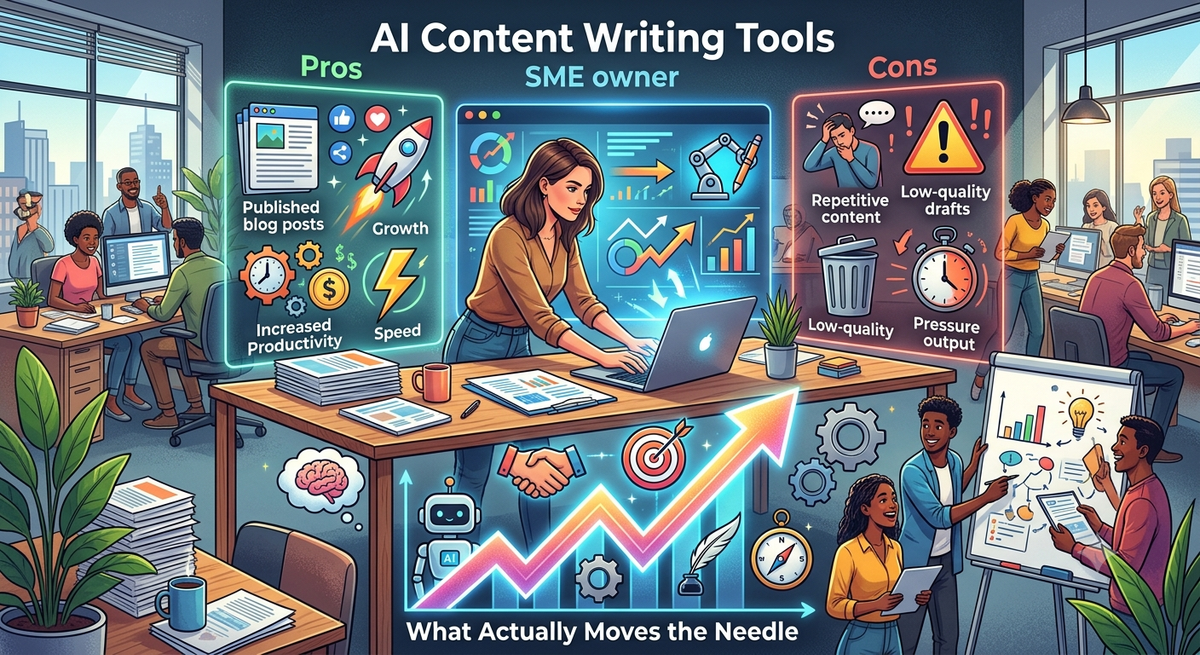
AI content writing tools have become a standard part of the SME marketing toolkit — and for good reason. They cut production time, reduce cost, and let small teams punch above their weight. But the gap between "we use AI for content" and "our content drives real local visibility" is where most businesses quietly stall. This post breaks down the honest pros and cons of AI content tools from a content writer and marketer perspective, and explains what the tools alone can't do — particularly for multi-location service brands competing in local AI search.
Key Takeaways
- AI writing tool adoption is accelerating fast — a Siege Media + Wynter 2026 study found 97% of content marketers plan to use AI writing tools in 2026, up from 64.7% in 2023.
- Quality gains are real but require human review — Semrush research reports 79% of businesses see an increase in content quality with AI tools, yet 86% of marketers still edit AI-generated content before publication.
- Speed is the clearest win — 36% of marketers who use AI spend less than one hour writing a long-form blog post, according to Semrush.
- Generic AI content won't win local AI search — Ask Maps shows only 3–8 businesses per query; without branch-specific, Gemini-readable content, your location doesn't appear.
- Brand AEO ≠ Local AEO — centralized brand content built with standard AI tools won't rank locally; each branch needs its own proof to surface in Google Ask Maps recommendations.
- Paigent automates branch-specific content at scale — 10, 50, or 150+ branches can go live in 1–3 weeks, with no marketing team required and a 14-day free trial on every plan.
---
What AI Content Writing Tools Actually Do Well
AI writing tools are productive. That's the honest starting point.
For SMEs with limited headcount, the time savings alone justify the adoption. A marketer who once spent a full day drafting a service page can now review and publish one in under an hour. A social post that required a copywriter briefing can be generated in seconds. At the volume SMEs need to compete online — blog posts, FAQs, location pages, product descriptions — AI tools remove the production bottleneck.
The quality picture is more nuanced. Semrush research puts the quality improvement figure at 79% of businesses, but that comes with a condition: 60% of marketers now use AI tools daily, and nearly all of them still edit before publishing. AI gives you a strong first draft. It doesn't replace judgment about what to say, who you're saying it to, or whether the output matches your market.
For AEO and SEO purposes, AI tools are particularly useful for generating FAQ content, structuring headings around search intent, and maintaining consistent topical coverage across a content calendar. They also help smaller teams maintain publishing frequency — which is a real ranking signal, especially for local service categories where competitors often go silent for weeks.
The core limitation at this stage: most AI writing tools generate content at the brand level. They don't know your Northside branch is different from your Eastside branch. They don't generate location-specific proof. And that distinction matters more now than it did two years ago.
---
The Real Cons: What Marketers Don't Talk About Enough
Honest assessment from a content and marketing perspective.
Generic output is the biggest risk. AI tools trained on web-scale data produce web-average content. Your service page about HVAC repair will read like every other HVAC service page unless you inject specific, location-level detail: the neighborhoods you serve, the common issues in that area, the technicians on the ground there. Most tools don't prompt for this. Most users don't think to add it.
Brand voice drift is real. AI writing tools will produce content that sounds consistent in style, but "consistent" and "on-brand" aren't the same thing. Without enforced brand voice parameters, output across dozens of pages or posts gradually shifts — different tone in the FAQ than in the service page, different formality on social versus the blog. For multi-location brands, this compounds. Each branch ends up with slightly different framing, and none of it feels authoritative.
AI content alone doesn't signal local trust. Search engines and AI answer engines like Gemini evaluate content authority at the location level. A page that discusses your service without referencing specific geographic context, local service history, or community-level proof doesn't tell Gemini which market you serve. It tells it nothing useful for local ranking.
Over-reliance creates content without strategy. Generating content is easy. Generating content that answers the right question, for the right audience, at the right stage of their search — that still requires a human layer. SMEs that automate production without auditing intent often end up with high-volume, low-impact content.
These aren't reasons to avoid AI tools. They're reasons to be deliberate about how you deploy them — and to understand what generic AI content can't do for your local visibility.
---
Deep Dive: Comparing Popular AI Content Tools for SMEs
To better understand how AI tools serve SME content needs, let's look at some popular options, keeping in mind the critical requirements for local relevance and search engine authority.
1. ChatGPT / Gemini (Generative AI Models)
These large language models (LLMs) are often the first introduction for many to AI content generation due to their accessibility and versatility.
- Pros:
Versatile for Ideation: Excellent for brainstorming topics, generating outlines, and drafting initial paragraphs or sections based on a broad prompt. Summarization & Rewriting: Can quickly summarize long texts or rephrase content to fit a different tone or length. Accessibility: Free or low-cost tiers make them accessible to nearly any business. Understanding Search Intent: Can help identify common questions or topics related to a keyword.
- Cons:
Generic Outputs: Without highly specific and detailed prompting, outputs are often general and lack unique insights, specific brand voice, or crucial local context. Lack of Factual Accuracy & Recency: May "hallucinate" information or provide outdated data, requiring rigorous human fact-checking. No Automation for Deployment: These models generate text; they don't automate content publishing, Google Business Profile synchronization, or schema markup. Limited Local Specificity: They lack inherent knowledge of micro-market details, specific branch services, or hyper-local community information unless explicitly provided.
2. Jasper (Dedicated AI Writing Platforms like Copy.ai, Writesonic)
Dedicated AI writing platforms are built with marketers in mind, offering structured workflows and templates.
- Pros:
Structured Workflows & Templates: Offers specific templates for blog posts, ad copy, product descriptions, social media posts, and more, streamlining content creation. Brand Voice Consistency (with training): Can be trained on existing content to mimic a specific brand voice, leading to more consistent outputs than general LLMs. SEO Integrations: Many platforms integrate with SEO tools (e.g., Surfer SEO with Jasper) to help optimize content for keywords during the drafting process. Efficiency for Polished Drafts: Good for producing relatively polished first drafts quickly, reducing the time spent on initial content generation.
- Cons:
Brand-Level Focus: Primarily designed to generate content at a brand or product level. Requires significant manual input and customization to inject location-specific details for multi-location businesses. Cost: Subscription-based, which can become a significant expense for SMEs, especially if not fully utilized. Human Oversight Still Required: While more sophisticated, human review is still essential for factual accuracy, nuance, and alignment with market specifics. Limited Local Automation: Does not automatically manage Google Business Profile updates, generate location-specific schema, or tie content directly to local ranking signals beyond basic keyword optimization.
3. Grammarly (AI-Powered Writing Assistants like ProWritingAid)
While often grouped with AI tools, Grammarly serves a distinct purpose as a writing assistant rather than a content generator.
- Pros:
Grammar, Spelling, & Punctuation: Unrivaled in correcting basic writing errors, ensuring professional, error-free text. Style & Tone Consistency: Offers suggestions to improve clarity, conciseness, and tone, helping maintain a consistent brand voice across all communications. Plagiarism Checker: A valuable tool for ensuring originality, especially when working with human-written or AI-generated content. Enhances Existing Content: Excellent for refining and polishing any text, whether drafted by a human or another AI tool.
- Cons:
Not a Content Generation Tool: Its primary function is to enhance and correct existing text, not to create new content from scratch. No Strategic Input: Does not assist with content strategy, keyword research, SEO optimization, or the generation of content types like FAQs or location pages. * Doesn't Address Local SEO: Has no functionality for managing local business profiles, generating geo-specific content, or building local authority signals.
In summary, while general AI content tools offer significant productivity gains, they largely operate at a brand level. They require substantial human intervention to imbue content with the local specificity, factual accuracy, and strategic intent necessary for truly moving the needle in local AI search.
---
How AI Content Fits Into AEO, GEO, and SEO Strategy
Three disciplines. Distinct goals. Overlapping signals.
SEO (Search Engine Optimization) targets organic ranking in traditional search results. AI content tools help here by maintaining topical authority, publishing frequency, and keyword alignment. The gains are real but incremental — and increasingly, they don't capture users who've shifted to asking Google conversational questions directly.
AEO (Answer Engine Optimization) targets the featured snippets, direct answers, and AI-generated responses that appear before traditional results. This is where FAQ schema, structured content, and clear question-answer formatting matter. AI tools can generate this content type efficiently, but they need to be prompted with the right intent questions.
GEO (Generative Engine Optimization) is the newest layer — optimizing for AI-generated responses in tools like Gemini, ChatGPT, and Perplexity. GEO requires content that's structured, cited, and locally specific. This is where most AI writing tools fall short. They generate plausible content; they don't generate content that Gemini reads as authoritative for a specific location.
The critical gap: Ask Maps — Google's AI-powered local recommendation layer in Maps — shows only 3–8 businesses per query. That's not a ranking of dozens. It's a very short list. Getting onto it requires branch-specific proof: location pages, FAQ schema tied to local intent, and review signals from that specific address. Generic AI content, however well-written, doesn't produce this.
For multi-location service brands, this is the real strategic question. Not "should we use AI for content?" but "is our AI content strategy building local AEO authority for each branch, or just producing volume?"
---
How Paigent Approaches AI Content for Local AEO
Paigent isn't a content creation tool in the traditional sense. It's an Ask Maps visibility platform — and that distinction matters.
Here's the workflow:
- Set your brand voice and business model. Paigent captures your tone, service categories, and positioning so every piece of generated content stays on-brand across every branch and topic.
- Add your branch locations. Whether that's 10 branches or 150+, Paigent maps each one and pulls location-specific data — neighborhoods served, local service intent, Google Business Profile signals.
- AI identifies branch-level search intent. Instead of generating generic content, the platform identifies what customers in each micro-market are actually searching for: "emergency HVAC repair in [suburb]", "pet grooming near [neighborhood]", "dental clinic open Saturday in [area]".
- Branch-specific, Gemini-readable content is generated. This includes branch profiles, service pages, FAQ schema (LocalBusiness, FAQPage, Review JSON-LD), and review proof — all tailored to the individual location.
- Content deploys with daily Google Business Profile sync and weekly content refresh. Freshness is a signal. Paigent maintains it automatically.
- Ask Maps authority builds over 4–8 weeks. As content publishes and signals accumulate, each branch builds the location-specific proof Ask Maps needs to recommend it.
For a dental clinic with six locations, this means six distinct content footprints — not one brand page duplicated six times. For an HVAC and plumbing operator with 30 branches, it means 30 separate Ask Maps signals building in parallel, without a single marketing hire.
The Review to Post feature converts customer reviews into published Instagram posts and Reels automatically, with the first post publishable in under a minute — adding social proof to the content signal without manual production.
---
Why Choose Paigent
Paigent automates Ask Maps visibility for every branch — each location ranks for its own local AI search without manual content work. That's not a generic positioning claim. It's the specific problem the platform was built to solve.
The core differentiation: Paigent generates branch-specific, Gemini-readable content at scale — branch profiles, service pages, FAQ schema, and review proof tailored to each location. Other tools generate content. Paigent generates the kind of content that gets you into Google Ask Maps' top 3–8 recommendations. Those are the only results that matter in local AI search.
It's built for multi-location operators. Cleaning service companies, electricians, pet grooming brands, real estate teams, salons — 10, 50, or 150+ branches live in 1–3 weeks. No marketing team required.
The platform also solves the Brand AEO ≠ Local AEO gap directly. Centralized brand content won't rank locally. Without location-specific proof, Ask Maps picks a competitor. Paigent ensures every branch has its own proof — always on-brand, always fresh, always optimized for local intent.
Plans start at $9/month (Starter) with a 14-day free trial on every plan, no credit card required. The Growth Plan at $19/month covers five locations and is the most popular entry point for small multi-location operators. Annual plans include two months free.
---
Who Paigent Is Best For — and Who Might Consider an Alternative
Paigent is best suited for multi-location service brands with three or more branches that need each location to appear in Google Ask Maps for local "near me" queries. If your customers search for your service by category — "best electrician near me", "pet grooming open now" — rather than by your brand name, and you need that strategy automated rather than manually managed, Paigent is built for exactly that.
It's particularly well matched to operators who already rank reasonably well but see low walk-in traffic. That's a known pattern: customers are following AI recommendations in Ask Maps, not clicking organic results. Paigent addresses the signal gap that causes it.
If you're a single-location business, an online-only brand, or a business without a Google Business Profile, Paigent isn't the right fit — the platform is built around branch-level Google Business Profile optimization, and it needs physical locations to anchor its content signals.
If you need results in under 30 days, factor in the honest timeline: first Ask Maps lift typically appears in 4–8 weeks as authority builds. That's the nature of how Ask Maps signals accumulate — not a platform limitation, but a realistic expectation to set before you start.
If you want to manually control every line of content, Paigent's automated workflow will feel constraining. You approve content, but the generation and publishing are handled by the platform. That's the tradeoff for operating at scale without a team.
Operators looking for a pure AI writing tool — blog drafting, ad copy, general content creation — will find better-fit options in the broader AI writing category. Paigent is an Ask Maps visibility platform. The content it generates exists to win local AI recommendations, not to fill a general content calendar.
---
As you evaluate AI content tools for your SME or multi-location brand, the strategic question to anchor on is whether the content you're generating builds local AEO authority for each branch — or just adds volume. If you're running three or more locations and need each one to win its own local AI search, explore what Paigent can do at getpaigent.com.
---
Frequently Asked Questions
What makes AI content writing tools useful for SME businesses with limited marketing resources?
AI writing tools reduce content production time substantially. Semrush research reports that 36% of marketers who use AI spend less than one hour writing a long-form blog post. For SMEs without dedicated copywriters, this means service pages, FAQs, and blog content can be produced at a pace that supports consistent publishing — a real signal for both search engine ranking and answer engine citation. General generative AI models like ChatGPT and dedicated platforms like Jasper can accelerate drafting, while tools like Grammarly ensure quality.
How do AI content tools affect AEO and GEO performance for local service businesses?
AI tools help with AEO by generating FAQ-structured content and direct-answer formatting that answer engines can extract. For GEO — specifically Google's Ask Maps — generic AI content from tools like ChatGPT or Jasper is less effective. Ask Maps evaluates location-specific proof: branch profiles, local FAQ schema, and review signals tied to a physical address. Content without this local specificity typically doesn't surface in Ask Maps' 3–8 business recommendations.
What is the Brand AEO vs. Local AEO gap, and why does it matter for multi-location brands?
Brand AEO means your overall brand appears in AI-generated answers. Local AEO means each individual branch appears when someone searches "near me" in a specific neighborhood. Centralized brand content from general AI tools won't rank locally — Ask Maps evaluates signals at the branch level. Without location-specific content for each branch, Ask Maps picks a competitor whose location has that proof established.
How does Paigent generate branch-specific content differently from a standard AI writing tool?
Paigent identifies location-specific search intent for each branch, then generates Gemini-readable content — branch profiles, service pages, FAQ schema (including LocalBusiness and FAQPage JSON-LD), and review proof — tailored to each individual location. It also maintains a daily Google Business Profile sync and weekly content refresh. A standard AI writing tool (like Jasper or ChatGPT) generates content on request; Paigent automates the full Ask Maps signal-building workflow for every branch simultaneously.
How long does it take to see Ask Maps visibility results after deploying branch-specific content?
First Ask Maps lift typically appears within 4–8 weeks of content deployment. Ask Maps authority builds as content publishes, Google Business Profile signals accumulate, and freshness is maintained through regular updates. This timeline applies across verticals — from cleaning services to dental clinics to HVAC operators. Operators expecting results within 30 days should factor this build period into their planning.
Which types of multi-location service businesses benefit most from automated local AEO content?
Multi-location service brands where customers search by category — "HVAC repair near me", "pet grooming open Saturday", "dental clinic [neighborhood]" — benefit most. Paigent covers verticals including salons, pet grooming, dental clinics, HVAC and plumbing operators, electricians, real estate teams, and cleaning services. The platform is designed for operators with three or more branches who need each location to rank independently in Ask Maps.
Is Paigent suitable for a business that wants to use AI for general content creation alongside local SEO?
Paigent is an Ask Maps visibility platform, not a general-purpose AI writing tool. It generates content specifically to build branch-level authority in Google Ask Maps — branch profiles, local service pages, FAQ schema, and review-based social content via the Review to Post feature. If your primary need is blog drafting, ad copy, or general content production rather than local AI search visibility, a broader AI writing tool like Jasper, ChatGPT, or Gemini (complemented by Grammarly for editing) would be a better fit.