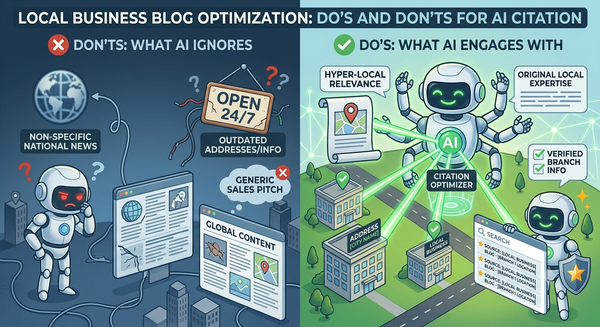
Why High-Ticket Businesses Can't Afford to Ignore AEO
High-ticket brick-and-mortar businesses with a GBP can't afford to ignore AEO. See the data on Ask Maps behavior, buyer psychology, and how Paigent automates local AI visibility.

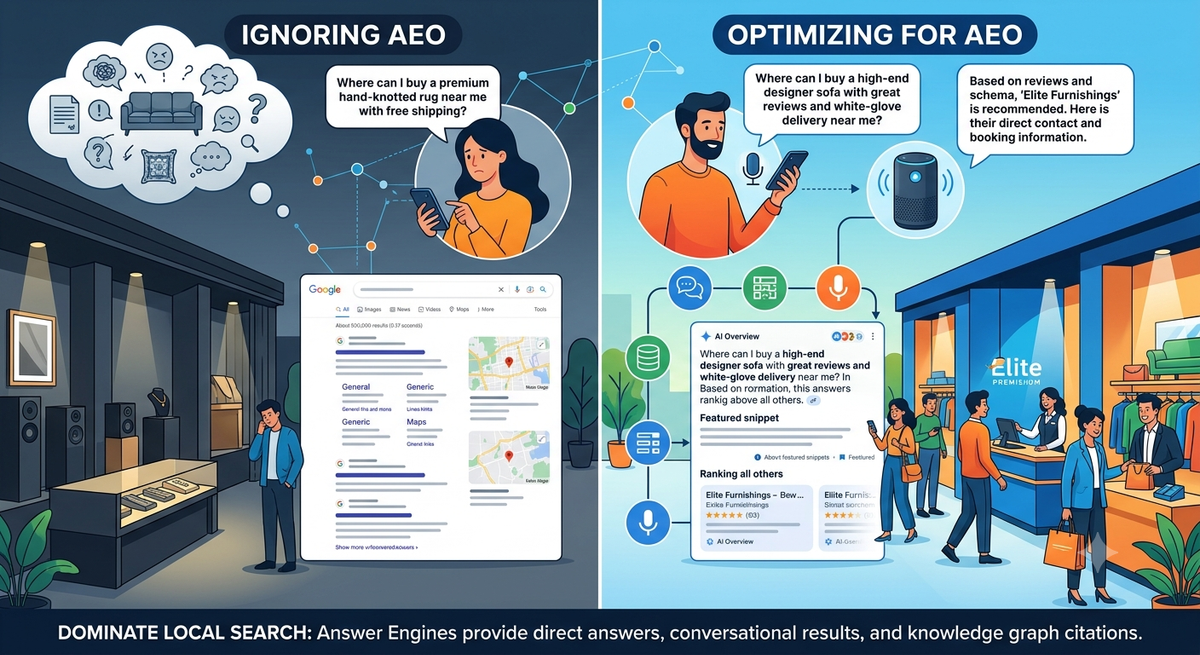
When someone is about to spend $5,000 on a luxury renovation, $15,000 on a legal retainer, or $300,000 on a real estate transaction, they don't type two keywords and pick the top result. They ask questions. Long, specific, comparative questions — and increasingly, they're asking them inside Google Maps, ChatGPT, Gemini, and Perplexity. If your business isn't optimized to appear in those AI-generated answers, you're invisible at the exact moment a buyer is ready to commit. This post makes the case — with data and behavioral research — for why high-ticket, brick-and-mortar businesses with a Google Business Profile need to treat Answer Engine Optimization as a core revenue strategy, not a nice-to-have.
Key Takeaways
- Ask Maps surfaces only 3–8 businesses per local query — meaning the vast majority of your competitors don't exist to the buyer, regardless of their traditional SEO ranking.
- 89% of local searches now happen as conversations inside Google Maps — a fundamental shift in how buyers research high-consideration purchases before ever visiting a location.
- High-ticket ecommerce conversion rates run between 0.5% and 1.5% — reflecting long sales cycles and high buyer risk, which makes pre-qualified AI referral traffic exponentially more valuable than broad organic traffic.
- 78% of local service brands are currently invisible to Ask Maps — making early optimization a competitive window that will close as awareness grows.
- Paigent generates branch-specific, Gemini-readable content at scale, publishing LocalBusiness, FAQPage, and Review JSON-LD schema so each location ranks independently in Ask Maps' 3–8 recommendations.
- Setup takes 1–2 weeks, with first Ask Maps results appearing in 4–8 weeks — built for multi-location operators who don't have a marketing team managing it manually.
The Way High-Ticket Buyers Search Has Changed
Forget the "near me" keyword. A consumer spending a few hundred dollars on a routine service picks the first rated option in the Local 3-Pack and moves on. The decision takes seconds.
A high-ticket buyer behaves completely differently. Their journey is cautious, comparative, and conversational. Instead of "estate lawyer New York," they ask: "Which corporate law firms in New York have documented experience setting up international SaaS holding structures?" That's a conversation, not a query.
AI engines — Google's Ask Maps, ChatGPT, Gemini, Perplexity — are built to answer exactly this type of question. They don't return ten blue links and leave the buyer to sort through them. They synthesize, filter, and surface two to four businesses that match every element of the prompt: location, specialization, reputation signals, and structured data coherence.
And here's the operational reality: Ask Maps shows 3–8 businesses per query. That's the entire competitive set. If your GBP data is incomplete, your schema is missing, or your content doesn't match the buyer's specific question, the AI skips you entirely. Not because you're bad at what you do. Because it can't read you confidently enough to recommend you.
High-ticket buyers also use AI as a trust filter, not just a search tool. They're not looking for the first name that appears. They're looking for the name that appears with the right signals: specialization, authority, location coherence, and review sentiment that matches their specific need. That's a fundamentally different game than ranking on page one.
Why Your Google Business Profile Is Now an AI Entity Node
Your GBP is no longer a map listing. It's a structured data node feeding directly into Google's Knowledge Graph — the underlying entity database that AI engines query when answering local questions.
When an AI model processes "best premium dermatologist with short wait times and a private entrance," it doesn't just count stars. It reads the semantic text of your reviews, cross-references your GBP service categories, checks your website schema for consistency, and looks for third-party mentions that corroborate your positioning. If any of those signals contradict each other, the model treats your listing as unresolved and moves on.
For high-ticket businesses, this matters more than for any other category. A buyer spending five figures on a service is naturally risk-averse. The AI model reflects that caution. It performs a web-wide consensus check before surfacing a recommendation, and it won't recommend a business whose data tells three different stories.
Completeness is the baseline. Beyond that, what actually drives Ask Maps visibility is coherence: your GBP categories, your schema markup, your website content, and your review text all reinforcing the same specific positioning. Google sees coherence. Coherence equals visibility.
The businesses winning Ask Maps recommendations today aren't necessarily the most famous or the highest-rated. They're the ones whose digital footprint is the clearest, most structured, and most consistently aligned to the specific queries high-ticket buyers are asking.
How Paigent Builds Ask Maps Visibility for High-Ticket Locations
This is specifically where Paigent's local AEO solution operates — not as a traditional SEO tool, but as an automated Ask Maps infrastructure builder for multi-location brands.
- GBP synchronization begins day one. Paigent connects to your Google Business Profile via daily sync, pulling live review data and profile signals for every branch automatically.
- Branch-specific content is generated at scale. Using Claude Haiku AI, Paigent generates four content types per location: an optimized location profile, service pages, FAQ schema, and review proof — all Gemini-readable and structured for Ask Maps extraction.
- Three schema types are published per branch. LocalBusiness, FAQPage, and Review JSON-LD schema are deployed so each location ranks independently in Ask Maps' 3–8 recommendations — not as a single brand entity, but as a distinct local authority.
- Review collection runs in 77 languages via voice and text. Paigent's review management solution captures review signals across your customer base, feeding fresh semantic data into your GBP continuously.
- Google reviews become Instagram content in 60 seconds. The Review to Post feature converts your existing review text and customer photos into branded Instagram posts and Reels — turning social proof into visible content without a creative team.
- Content refreshes weekly, without manual input. The weekly refresh cycle keeps your branch profiles current and signals algorithmic freshness to Google — a key factor in sustained Ask Maps visibility.
Setup takes 1–2 weeks. First results in Ask Maps appear in 4–8 weeks. Paigent has deployed 12 HVAC/plumbing branches in 2 weeks and 25 cleaning service branches in 2 weeks.
The Revenue Argument: Why AEO Referral Traffic Converts Differently
For high-ticket businesses, lead quality matters more than lead volume. A buyer arriving from an AI engine recommendation has already been pre-filtered by the model against their own stated requirements — budget signals, location, specific expertise, and review sentiment.
That's a structurally different lead than someone who clicked a blue link after a broad keyword search. The AI did the qualification work before the referral happened.
This is why the conversion dynamic for AI-referred traffic looks so different from traditional organic traffic. High-ticket ecommerce conversion rates average between 0.5% and 1.5% — reflecting long sales cycles and high buyer caution. AI referrals compress that cycle because the buyer arrives already convinced that you're the right category fit. The remaining question is whether you close them, not whether they're qualified.
For physical high-ticket businesses, this plays out in concrete numbers. Paigent reports that real estate offices using Ask Maps optimization see 10–15 new qualified buyer leads per month from Ask Maps recommendations, with annual revenue increases of $100K–$200K per office. HVAC and plumbing branches in emergency-demand seasons report $200K–$300K in additional revenue per branch attributable to Ask Maps visibility. These aren't marketing estimates. They're the output of a system where the buyer found the branch through a structured AI recommendation at the exact moment of high intent.
For real estate teams and other high-ticket verticals, that's not a marginal improvement in visibility. It's a fundamental change in where qualified buyers come from.
Why Choose Paigent
Paigent automates Ask Maps visibility for every branch without a marketing team. That's the core claim, and it's built on specific infrastructure — not a general content tool or an SEO dashboard.
Each location ranks independently in Google Ask Maps' 3–8 recommendations. Paigent doesn't treat your brand as a single entity and push brand-level content. It generates branch-specific proof: individual profiles, service pages, FAQ schema, and review proof for every location. Brand AEO is not the same as local AEO — and a brand-level strategy leaves every individual branch competing for the same signal.
Paigent generates branch-specific, Gemini-readable content at scale. The system is built on three schema types (LocalBusiness, FAQPage, Review JSON-LD) deployed per branch, with daily GBP sync and a weekly content refresh cycle. Google sees a coherent, freshly updated, structured entity for every location. That's what drives Ask Maps citations.
The 77-language voice and text review collection means every customer interaction — regardless of language — feeds back into the GBP profile as a structured trust signal. And turning Google reviews into Instagram posts and Reels in 60 seconds means your social presence stays active without a creative hire.
Plans start at $9/month (Starter, 2 locations) through $39/month (Pro, 15 locations). Every plan includes a 14-day free trial, no credit card required. If you've downloaded no generated content, a full refund is available within 14 days of purchase.
For multi-location brands — HVAC and plumbing operators, general contractors, real estate teams, and others in high-ticket local verticals — this is built for exactly your operating model.
Who Paigent Is Best Suited For — and Who Might Consider an Alternative
Paigent is built for multi-location brands with 3 or more branches whose customers search locally and who don't have a marketing team running strategy. If your business fits that profile, the automation is designed for your exact operating reality: one central brand voice, branch-specific content generated automatically, and Ask Maps rankings that build over 4–8 weeks without manual input.
If you're a single-location business, Paigent isn't structured for you. The infrastructure is designed around branch-level independence — it requires at least 3 locations to operate as intended.
If you need results within 30 days, the timeline is honest: first Ask Maps appearances take 4–8 weeks. That's not a limitation to apologize for — it reflects how AI citation authority actually builds. But if your situation demands immediate lead flow, a paid search campaign will move faster.
If you want manual control over every piece of content, the automated system won't fit. Paigent is built for operators who want the output, not the process. If granular creative control matters more than scale and automation, a bespoke content agency is a better fit.
If you're an online-only business with no Google Business Profile, Ask Maps optimization has no surface to work with. This is a tool for physical locations with a GBP.
The gap the system is built to close is specific: high-ticket local businesses with multiple branches that are losing Ask Maps visibility because 78% of local service brands currently don't appear in those 3–8 recommendations at all.
If your business fits the model, start with Paigent's 14-day free trial — no credit card required, setup in 1–2 weeks, and your first Ask Maps results within the month after.
Frequently Asked Questions
Why do high-ticket businesses specifically need AEO rather than standard local SEO?
High-ticket buyers research differently. They ask long, specific, conversational questions inside AI engines like Google's Ask Maps, Gemini, and Perplexity — not short keyword searches. AEO optimizes your business to appear in those AI-generated answers. Standard local SEO targets blue-link rankings, but AI overviews now appear in a large share of commercial queries, and organic click-through rates drop significantly when they trigger. For high-ticket businesses, being absent from AI answers means missing the buyer at peak intent.
How does a Google Business Profile feed into Ask Maps recommendations for high-ticket local searches?
Google's AI engines treat your GBP as a structured entity node — not just a map listing. When answering a high-consideration query, the AI cross-references your GBP service categories, schema markup, website content, and review text for consistency. Contradictory or incomplete signals cause the AI to skip your business. Paigent runs daily GBP synchronization and deploys LocalBusiness, FAQPage, and Review JSON-LD schema to give each branch a coherent, machine-readable profile that Ask Maps can confidently cite.
How long does it take to appear in Ask Maps results after setting up AEO?
With Paigent, setup takes 1–2 weeks and first Ask Maps results typically appear within 4–8 weeks. AI citation authority builds as the system publishes branch-specific content, refreshes it weekly, and feeds fresh review signals into the GBP continuously. This is not an instant-results system — it's infrastructure that compounds. Businesses needing leads within 30 days should combine Ask Maps optimization with a parallel paid channel during the build period.
Can a high-ticket business with multiple locations rank each branch independently in Ask Maps?
Yes — and this is the core distinction between brand AEO and local AEO. A brand-level strategy pushes a single entity signal, which means individual branches compete against each other. Paigent generates branch-specific proof for every location: individual optimized profiles, service pages, FAQ schema, and review proof. Each branch publishes its own LocalBusiness, FAQPage, and Review JSON-LD schema, so each location ranks independently in Ask Maps' 3–8 recommendations rather than as a diluted brand presence.
What types of high-ticket brick-and-mortar businesses does Ask Maps optimization apply to?
Ask Maps optimization is directly relevant to any high-ticket local business where buyers research before visiting: premium real estate agencies, luxury renovation contractors, specialized medical or dental clinics, HVAC and plumbing companies handling large-scale emergency or installation work, and legal or financial services with a physical location. Paigent's infrastructure is deployed across verticals including real estate teams, HVAC and plumbing, and general contractors, among others.
How does review text affect whether a high-ticket business appears in AI-generated local recommendations?
AI engines don't just count stars — they read the semantic content of review text. A buyer asking for "a premium dermatologist with short wait times and a private entrance" triggers an AI scan of GBP review text for those specific attributes. Paigent collects reviews via voice and text in 77 languages and feeds that semantic data back into each branch's GBP continuously. More review text with specific service language gives the AI more confident material to match against buyer queries.
Is Paigent a replacement for a marketing agency, or does it work differently?
Paigent is an automated platform, not a done-for-you agency. It generates and publishes branch-specific, Ask Maps-optimized content at scale without requiring a marketing team to manage it. What it automates — schema deployment, GBP sync, weekly content refresh, review collection, and social content generation — typically requires ongoing agency retainer work when done manually. For multi-location operators who want Ask Maps visibility without staffing a marketing function, that's the core value. If you need bespoke creative strategy or manual control over every detail, a traditional agency fits that need better.