Every Store Is Invisible in Local AI Search Without Branch-Specific Content
Learn why multi-location brands go invisible in local AI search and how branch-specific content signals are what Ask Maps actually reads to rank each store.

When someone asks Google "best salon near me" or "HVAC repair in [neighborhood]," the answer they get isn't a list of links anymore. It's a direct recommendation from Ask Maps — and it names three to eight businesses, then stops. If your branch isn't one of them, it doesn't exist for that shopper. This post explains why that happens, what signals Ask Maps actually reads, and how multi-location brands can fix the gap before a competitor fills it.
Key Takeaways
- Ask Maps surfaces 3–8 businesses per local query — not a ranked page of ten blue links, meaning the competition for each slot is winner-take-most.
- Centralized brand content doesn't rank locally — a single brand website cannot tell Ask Maps which specific branch is the right answer for a shopper in a given neighborhood.
- 78% of local service brands are invisible to Ask Maps — branch-specific proof (profiles, service pages, FAQ schema, review signals) is what creates visibility at the location level.
- Multi-location brands with fully optimized local profiles achieve up to 65.7% Google 3-pack presence, compared to 33.4% for the average, according to SOCi (2024) research.
- Paigent deploys branch-specific, Gemini-readable content across 6–25 branches in 2–3 weeks, including LocalBusiness, FAQPage, and Review JSON-LD schema per location.
- First measurable Ask Maps lift typically appears in 4–8 weeks — Ask Maps authority builds as content publishes and signals accumulate, not overnight.
---
Why Most Local Searches End Before They Reach Your Website
Ask Maps is not a search engine in the traditional sense. It doesn't surface ranked links and let users decide. It reasons over available signals, picks the most locally credible answer, and presents it as a direct recommendation. The shopper reads the answer. They call the business. They walk in.
That reasoning process pulls from structured signals: a Google Business Profile with fresh, accurate data; location-specific service pages that match the search intent; FAQ schema that Gemini can parse; and review proof that demonstrates the branch serves that specific area.
What it does not pull from is your corporate homepage. Your brand website was built to explain the company as a whole. It tells the story of the organization, its mission, its national footprint. None of that answers the question "which of these ten salon branches is the right one for a shopper standing three blocks away?"
SOCi's "High Cost of Invisibility" research puts a number on what this costs — poor local search visibility costs the U.S. retail industry an estimated $2.4 billion annually. That's not a ranking problem. It's an invisibility problem, and it operates at the branch level, not the brand level.
The gap is structural. Brand AEO and Local AEO are different games. Winning the first doesn't move the needle on the second.
---
The Signal Stack Ask Maps Reads at the Branch Level
Understanding why branches go invisible requires understanding what Ask Maps is actually scoring.
Google's Gemini layer in Ask Maps evaluates local relevance by looking for coherence across a cluster of signals tied to a specific location. These aren't arbitrary ranking factors — they map directly to the questions a shopper is implicitly asking.
Geographic specificity. Does this branch's content reference the actual neighborhood, service area, and surrounding landmarks? Generic content that could apply to any city reads as low-confidence to Gemini.
Service-level proof. Does this location have dedicated pages for the specific services it offers? A branch of a dental group that has a single shared services page is less readable than one with its own implant consultation page, whitening FAQ, and emergency appointment schema.
Review coherence. Are reviews recent, location-specific, and echoing service language? Reviews that mention the branch address, the technician's name, or the neighborhood add geographic and topical signals. A corporate review pool shared across all locations contributes far less.
Schema markup. LocalBusiness, FAQPage, and Review JSON-LD tell Gemini exactly what this entity is, where it operates, what it does, and what customers say. Without schema, the AI has to infer — and inference loses to explicit declaration.
GBP freshness. A profile that syncs regularly signals an active, operating business. Stale profiles get deprioritized not because of a penalty, but because Gemini has lower confidence in their current accuracy.
Each of these signals is location-specific by definition. You cannot centralize them.
---
How Branch-Specific Content Generation Works at Scale
For a brand with 10, 50, or 150 branches, producing this signal stack manually per location is not a realistic operation. It would require a writer per location, a schema specialist, a GBP manager, and a review aggregator — all coordinated, all kept current. Most multi-location operators don't have that team.
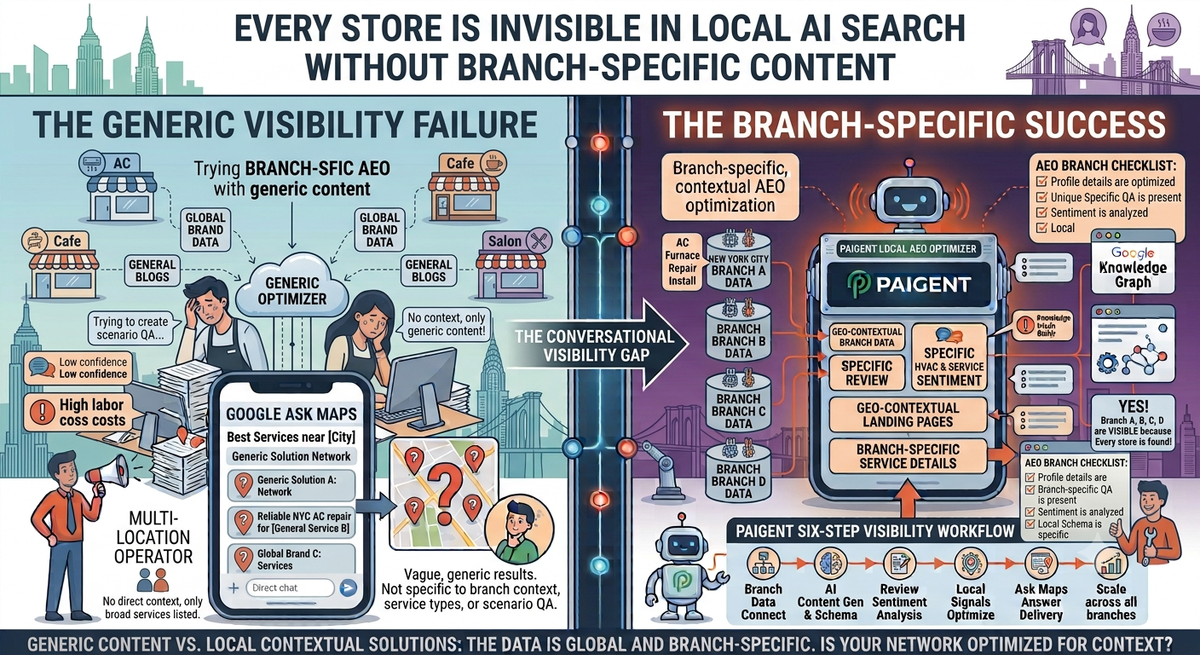
The structural solution is to automate content generation at the branch level while keeping the output coherent with brand voice and accurate to each location's actual services and geography. Here's how that process runs in practice with Paigent:
- Branch data ingestion. Each location's GBP data, service offerings, and geographic details are pulled in. Paigent requires a minimum of three branches to activate — this is the threshold where location-level differentiation becomes both necessary and tractable at scale.
- Branch profile generation. Paigent generates a distinct profile for each location: neighborhood-specific service descriptions, operating context, and micro-market framing. Not a template with a city name swapped in. A genuinely location-differentiated content set.
- Schema deployment. LocalBusiness, FAQPage, and Review JSON-LD schema are deployed per branch — giving Gemini the structured declarations it needs to confidently recommend each location for relevant local queries.
- Review signal integration. Existing reviews are incorporated as proof signals. Voice review collection in 77 languages (processed locally on device via Web Speech API) makes it easier for customers to contribute, building the review coherence Ask Maps reads.
- Publishing and GBP sync. Optimized pages auto-publish. GBP syncs daily. Content refreshes weekly. The profile stays current without manual intervention.
- Visibility accumulation. Ask Maps authority builds as signals accumulate. First measurable lift typically appears in 4–8 weeks — not 30 days. The platform targets the Ask Maps 3–8 recommendation slots, with documented rollout speeds of 8–25 branches live in 2–3 weeks depending on vertical.
This is the model Paigent runs across cleaning services, electricians, home services, general contractors, dental clinics, HVAC companies, and a range of other multi-location service verticals. The Paigent Ask Maps Visibility Platform page outlines which operator types it's built for and what the setup sequence looks like.
---
The Brand AEO vs. Local AEO Gap — and Why It Persists
This is the distinction most multi-location marketing strategies miss, and it's worth being direct about it.
Brand AEO is about making your organization the authoritative answer to category-level questions. "What is the best HVAC company?" or "Which dental group operates in the Southeast?" Winning those queries builds brand equity. It does not send walk-in traffic to Branch #14 in a specific zip code.
Local AEO is about making a specific branch the authoritative answer to a proximity query. "HVAC repair near me." "Teeth whitening in [neighborhood]." Those queries have a physical answer — a location that is actually near the searcher, actually offers the service, and has the content signals to prove it.
Ask Maps picks one winner per local search from those 3–8 slots. Without location-specific proof, Ask Maps picks a competitor. It's not a penalty; it's just arithmetic. The branch with more coherent local signals wins the slot.
The persistence of this gap comes down to how most brands structure their content investment. Corporate marketing budgets go toward brand-level content — national campaigns, corporate blog posts, brand authority signals. These are legitimate investments. They just don't solve the local visibility problem for Branch #14.
80% of Americans search online weekly for local service providers (SOCi, 2026). Most of those searches resolve in Ask Maps before a single link is clicked. If your branches aren't present in that answer layer, the brand-level investment isn't converting to foot traffic.
---
Who Paigent Fits — and Who Should Consider an Alternative
Paigent is built for a specific type of operator. Knowing whether you're in that set is worth a few sentences.
Best suited for: Multi-location brands with three or more physical branches that need each location to rank in Ask Maps for local "near me" queries. Operators in service verticals — HVAC, dental, salons, cleaning, real estate, pet grooming, home services, general contracting — where customers search locally and walk-in or call-in traffic matters. Brands with good brand-level recognition but low walk-in conversion (customers are finding competitors via AI recommendations instead).
If you're managing multiple dental clinic locations, a network of HVAC and plumbing branches, or a home services franchise with locations across several markets, the platform is designed for exactly that scale.
Consider an alternative if: You operate a single location. You run an online-only business with no physical branches. You don't have a Google Business Profile — Paigent can't optimize an Ask Maps presence without one. You need results in 30 days (first lift appears in 4–8 weeks). You want to manually control every line of content — Paigent automates the workflow; you moderate make required changes and approve output, but generation and publishing are handled by the platform. If you're looking for a generic content creation tool rather than an Ask Maps visibility platform, this isn't the right fit.
The automated workflow is a feature for operators who want scale without a dedicated marketing team. It's a constraint for operators who prefer manual oversight of every content decision.
---
Where Paigent Fits
Paigent is an Ask Maps visibility platform built specifically for multi-location service brands that need branch-level content authority generated and maintained at scale. It automates the signal stack — branch profiles, service pages, FAQ schema, review proof — that Ask Maps reads when deciding which location to recommend for a local query.
It doesn't replace a brand website. It doesn't compete with brand-level SEO. It fills the Local AEO layer that centralized content can't cover: the branch-specific proof each location needs to earn its own slot in Ask Maps recommendations.
Plans start at $9/month for two locations, with the Growth Plan at $19/month covering five locations (the most popular tier for early multi-location operators). Every plan includes a 14-day free trial with no credit card required.
---
If you're running a multi-location brand and want to see which branches are missing from Ask Maps today, start a free trial at getpaigent.com.
---
Frequently Asked Questions
What's the difference between local SEO and Ask Maps visibility?
Local SEO targets ranked search results — the organic links that appear below the map pack. Ask Maps visibility is about appearing in Google's AI-generated answer layer, where Gemini recommends 3–8 businesses directly in response to a local query. The signals that drive each outcome overlap but aren't identical. Ask Maps specifically weights structured schema, GBP freshness, review coherence, and location-specific content — not just domain authority or backlinks.
Why can't a brand's main website rank for individual branch locations?
A brand website is built to represent the organization as a whole. It lacks the geographic specificity, location-level schema, and neighborhood-anchored content that Ask Maps reads to determine which branch is the right answer for a shopper in a given area. Each branch needs its own content cluster — service pages, FAQs, and review signals tied to that specific location — to compete independently in local AI search.
How many locations does a multi-location brand need before branch-specific content becomes necessary?
The minimum threshold where branch-level differentiation becomes both necessary and operationally tractable is typically three locations. Below that, manual optimization per branch is manageable. At ten or more locations, the content volume required to maintain fresh, location-specific signals across every branch makes manual management impractical without dedicated headcount — which is where automated platforms become the relevant solution.
How long does it take to see Ask Maps lift after deploying branch-specific content?
Ask Maps authority builds as content publishes and signals accumulate. First measurable lift typically appears in 4–8 weeks after deployment — not in 30 days. The timeline reflects how Gemini indexes and weights new location signals. Rollout itself (branches going live with content and schema) typically takes 2–3 weeks, depending on the number of locations and service vertical.
What schema types matter most for branch-level Ask Maps visibility?
The three schema types most directly relevant to Ask Maps recommendations are LocalBusiness (entity declaration with address, hours, and service area), FAQPage (structured question-answer content Gemini can extract and cite), and Review (structured review proof tied to the specific location). Together, these give Gemini explicit declarations rather than requiring inference — and explicit declarations consistently outperform inferred signals in local AI recommendation results.
Does a multi-location brand need to replace its existing website to optimize for Ask Maps?
No. Branch-specific content for Ask Maps visibility is additive — it generates optimized location pages and schema that publish alongside the existing brand site. The brand website stays in place. The branch content provides the location-specific proof layer that Ask Maps reads, filling the gap that centralized brand content leaves open. The two serve different functions and operate on different content layers.
Which service verticals are most affected by the Brand AEO vs. Local AEO gap?
Any service vertical where customers search by proximity rather than brand name is exposed to this gap. That includes HVAC, dental, salon and beauty, cleaning services, pet grooming, general contracting, real estate, and home services broadly. In these categories, the typical shopper query is "best [service] near me" — a local intent query that Ask Maps resolves with branch-level recommendations, not brand-level authority.