SEO vs AEO: Same Content, Different Architecture — And Why Scale Changes Everything
SEO and AEO use the same content — the difference is structure, scale, and freshness. Learn how Paigent solves AI content decay for multi-location brands.

For multi-location businesses, the shift to AI answer engines like Google's Ask Maps introduces a unique challenge: maintaining perpetual visibility at scale. Traditional SEO models aren't enough. While your core business content remains vital, the demands of AI require not just specific architectural formatting, but also an ongoing, dynamic freshness that most marketing teams simply cannot manage across dozens of branches. This post reveals the hidden 'freshness gap' that quietly erodes AI visibility and explains how to build a content strategy that keeps every location actively recommended in local AI searches.
Key Takeaways
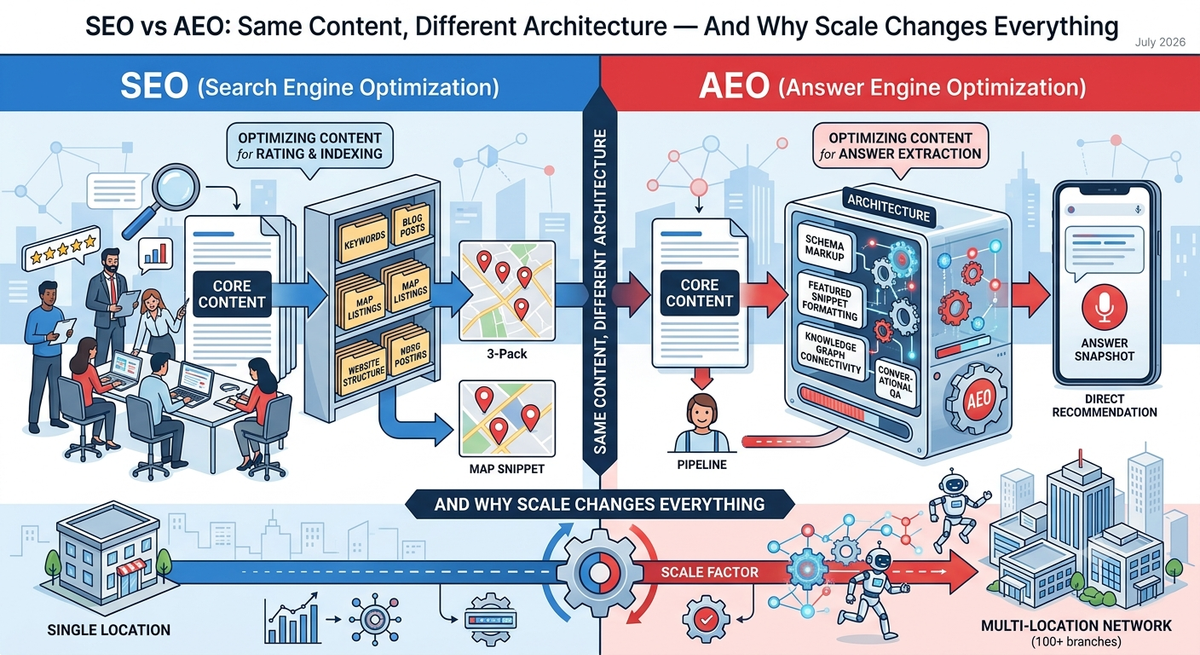
- SEO and AEO consume the same underlying content — the difference is structural: AEO demands answer-first formatting, FAQ schema, and structured data; traditional SEO rewards long-form coverage and topical authority without requiring that hierarchy.
- Ask Maps shows only 3–8 businesses per query, meaning your branch either earns a slot or doesn't appear at all — there is no page two.
- Content at scale and dynamically refreshed became mandatory for AEO, because each branch needs its own location-specific proof to rank independently in local AI recommendations.
- AI-generated content at scale degrades in freshness over time without active signals, creating an invisible gap between your published content and Google's freshness expectations.
- Paigent solves this with a daily GBP sync paired with a weekly content refresh cycle, keeping every branch's content alive without a marketing team touching it.
- Setup takes 1–2 weeks, and first Ask Maps results appear in 4–8 weeks — not instant, but structured for durable, compounding visibility.
Why AI Needs Structured Content: The Foundation for Multi-Location Visibility
For multi-location businesses aiming for local AI visibility, understanding the architectural shift is foundational. It's not about throwing out your existing content — the raw material of accurate, locally relevant information about your business and services remains the same. A blog about "emergency HVAC repair in Phoenix" still matters. The key difference lies in how that information is structured and delivered to an AI.
Traditional SEO content often prioritizes long-form coverage, depth, and topical authority, designed for linear reading by humans and crawling by search engines. FAQs might be an enhancement but aren't always central to the architecture.[1] In contrast, AI Answer Engines like Google's Gemini demand content formatted for rapid extraction of confident answers. The question-answer unit becomes the atomic building block. Content must be answer-first, with every section independently extractable. FAQ schema (specifically FAQPage JSON-LD) isn't optional; it's often the direct delivery mechanism that allows AI to reliably surface your business in conversational responses.
The practical implication for multi-location operators is clear: your existing content needs re-architecture. This means adding answer-first H2s, deploying FAQ schema, and ensuring every section answers a specific query before building context. This foundational restructuring transforms SEO-useful content into AEO-citable assets, preparing each branch for the demands of AI recommendation.
The Multi-Location AI Visibility Dilemma: Scale, Specificity, and The Need for Dynamic Content
Traditional SEO models, which rewarded patience and long-term authority building, are ill-equipped for the demands of local AI visibility at scale. A single pillar page might have served a single-location business well for years. But for a multi-location operator, the paradigm has shifted.
AI Answer Engines don't just "read documents"; they seek precise, contextual understanding to confidently recommend a business for a local, conversational query. This means "best heating repair near downtown Austin" and "emergency furnace fix in North Austin" are distinct queries, each requiring specific, branch-level proof to earn one of Ask Maps' precious 3–8 recommendation slots. The algorithm needs to understand that specific branch for that specific query.
For a franchise or multi-location operator with 15, 25, or 50 branches, this creates an immense content dilemma. Each location requires its own distinct profile, service content, FAQ schema, and review proof. That's four content types per branch, all needing to reflect the specific neighborhood, services, and team at that individual location. At 25 branches, you're looking at a minimum of 100 uniquely tailored content assets.
Generating this volume manually is simply impossible at pace, and maintaining it as each business evolves becomes an insurmountable task for any marketing team. This inherent demand for scale and specificity is why AI-assisted content generation is no longer just efficient, but structurally essential for multi-location operators seeking AI visibility. Indeed, 95% of bloggers now leverage AI for content production, reflecting the sheer volume needed.[2]
Are your branches earning their slots? Check your current Ask Maps Score with Paigent's Ask Maps visibility tool to see how many of your locations are being recommended right now.
The Freshness Problem No One Talks About
Scale creates a trap, especially for multi-location businesses. AI-generated content at scale is fast, consistent, and structurally sound. It is also, by default, static. And static content ages badly in the context of AI recommendations.
Google's freshness signals aren't just about publication date. They include review recency, GBP activity, structured data updates, and whether the content accurately reflects current service offerings for each specific branch. When a branch runs a winter promotion, changes its hours, or adds a new service, content that doesn't immediately reflect those changes starts sending incoherent signals. Google interprets this incoherence as irrelevance. Incoherence kills visibility.
The gap appears quietly. Your multi-location content is published. It looks fine. But over four to six months, with no active updates, no new review signals, and no GBP activity feeding into your structured content, your Ask Maps slot for that branch erodes. Other operators — possibly with less thorough content but more recent activity — take it. This is the silent killer.
This is why 78% of local service brands are invisible to Ask Maps. Not because they didn't produce content. But because the content they produced for their many locations went stale. For multi-location operators with no marketing team actively refreshing content across every branch, this is the default, devastating outcome: generate once, publish once, watch it silently decay.
How Paigent Solves the Freshness Problem at Branch Level
Paigent's core architecture addresses the freshness gap directly. The platform runs two overlapping refresh cycles: a daily GBP sync that pulls current review signals, hours, and profile updates from each branch's Google Business Profile, and a weekly content refresh cycle that uses those inputs to update the branch-specific content automatically.
This isn't just re-publishing old content with a new date. Each refresh ingests real signals from that specific branch — recent customer reviews, updated service data, seasonal promotions — and regenerates or updates the relevant content blocks. The result is content that stays coherent with what Google actually knows about your business today. Google sees coherence. Coherence equals visibility.
Paigent generates four content types per location: profile, services, FAQ, and review proof. It deploys LocalBusiness, FAQPage, and Review JSON-LD schema types so that Gemini-readable content is structured correctly for AI extraction. Every piece is branch-specific, not templated — a salon in Chicago and a salon in Dallas operate in the same brand but produce distinct content reflecting their local context. For operators running Paigent for Salons or Paigent for HVAC & Plumbing, this means each branch maintains an independent presence in Ask Maps' 3–8 recommendation slots without competing against sibling locations.
The platform has deployed 25 branches for a cleaning services operator in 2 weeks, 12 HVAC branches in the same timeframe, and 8 salons within a single week.
How Paigent Generates and Maintains Branch-Level Content: Step by Step
- Connect your Google Business Profiles. Paigent pulls your existing branch data, reviews, hours, and service details via GBP integration. No manual data entry per location.
- Paigent maps your brand voice centrally. You set the brand standards once. Every branch inherits that voice while generating content specific to its location, services, and customer base.
- The platform generates four content types per branch. Profile content, service pages, FAQ schema, and review proof — each structured for Gemini-readable output and optimized for Ask Maps' 3–8 recommendation slots.
- LocalBusiness, FAQPage, and Review JSON-LD schema deploys automatically. Structured data publishes alongside your existing website without replacing it — Paigent generates and publishes optimized pages alongside your existing site.
- Daily GBP sync captures fresh signals. New reviews, updated hours, seasonal changes — all feed back into the content layer within 24 hours.
- Weekly content refresh applies those signals. Each branch's content updates automatically, keeping the freshness signals Google uses to evaluate AI recommendation eligibility active and current — no marketing team required.
Why Choose Paigent
Paigent automates Ask Maps visibility for every branch without requiring a marketing team. That's the structural promise, and it's built into every feature decision.
Each location ranks independently in Google Ask Maps' 3–8 recommendations — branches don't compete against each other. The platform generates branch-specific, Gemini-readable content at scale, with the daily GBP sync and weekly refresh cycle directly solving the freshness decay that makes most AI-generated content invisible within months.
For operators comparing tools: Paigent is not a content creation tool and not a done-for-you agency. It's an automated Ask Maps strategy platform built for multi-location operators — one central brand voice, branch-specific content automatically. Reviews feed content. Content updates profiles. Profiles signal freshness. Everything reinforces everything else.
The Review Management solution collects reviews in 77 languages via voice and text, and Review to Post turns those Google reviews into Instagram posts and Reels in 60 seconds — real customer proof becoming both a freshness signal and a social asset simultaneously.
Every plan includes a 14-day free trial, no credit card required. The Pro Plan at $39/month covers 15 business locations, 100 Instagram posts, and 40 Reels monthly. Setup runs 1–2 weeks; first Ask Maps results appear in 4–8 weeks.
Who Paigent Is Best Suited For — and Who Might Consider an Alternative
Paigent is built for multi-location service businesses with 3 or more branches whose customers search locally and who don't have a marketing team running content strategy. Salons, HVAC operators, dental clinics, cleaning services, moving companies, real estate teams, and similar businesses where walk-in or local booking traffic matters directly. If you're running Paigent for Moving Services or [General Contractors](https://getpaigent.com/industries/general-con tractors), the platform's branch-level independence is the core value driver.
If you currently have one location, Paigent requires a minimum of 3 branches — a single-location business isn't the right fit. If you need results within 30 days, the 4–8 week timeline for first Ask Maps results means this platform won't meet that timeline. Businesses that want manual control over every content decision will find the automated system works against that preference — it's designed to run without human intervention per branch, not with it. Online-only businesses without a Google Business Profile won't activate the core value. And if walk-in or local traffic isn't a business objective, the Ask Maps focus won't move a meaningful metric for you.
For multi-location operators with the right profile, the Local SEO vs. Local AEO breakdown on Paigent's blog is worth reading before you start to understand what each channel is actually doing.
If you're building local AI visibility across 3+ branches and you don't have a team to run it manually, start your 14-day free trial at getpaigent.com.
Frequently Asked Questions
What is the structural difference between SEO content and AEO content?
SEO and AEO use the same underlying content — accurate, locally relevant information about your business. The structural difference is how that content is formatted. AEO requires answer-first H2 sections, FAQ schema (FAQPage JSON-LD), and independently extractable answer blocks so AI engines like Gemini can retrieve and cite a direct response. Traditional SEO prioritises depth, topical coverage, and backlinks without requiring that strict question-answer hierarchy.
Why does AEO require content generation at scale when traditional SEO didn't?
Traditional SEO allowed a single strong pillar page to rank broadly. AEO requires branch-specific proof for each location because Ask Maps recommends businesses for precise, local, conversational queries. A query for "emergency HVAC in North Austin" needs content specific to that branch. A 25-branch operator needs 100+ content assets — four types per location — to compete in Ask Maps' 3–8 recommendation slots. That volume cannot be produced or maintained manually.
What is the freshness problem with AI-generated content at scale?
AI-generated content is structurally sound but static by default. Over time, without updates reflecting new reviews, changed hours, seasonal services, or GBP activity, the content becomes incoherent with what Google currently knows about your business. Ask Maps deprioritises incoherent signals. The result is that a well-structured content library can erode from visibility within months — not because the content was wrong, but because it stopped reflecting current branch reality.
How does Paigent keep AI-generated content fresh across multiple branches?
Paigent runs two overlapping cycles: a daily GBP sync that pulls current review signals, updated hours, and profile changes from each branch's Google Business Profile, and a weekly content refresh that uses those inputs to update branch-specific content automatically. New reviews, seasonal promotions, and service changes feed back into structured content within the week — without a marketing team intervening per branch.
Does Paigent's content structure meet the schema requirements for Ask Maps recommendations?
Yes. Paigent deploys LocalBusiness, FAQPage, and Review JSON-LD schema types for each branch, structured specifically for Gemini-readable output. This means Google's AI engine can extract and verify branch-specific information — location, services, reviews, FAQs — from correctly formatted structured data rather than having to infer it from unstructured content. Each branch's schema is distinct, so locations rank independently rather than competing against each other.
Can a multi-location business maintain a consistent brand voice while generating location-specific content?
This is the central architectural challenge Paigent is designed to solve. Brand voice is set centrally once. The platform then generates branch-specific content — reflecting local services, nearby landmarks, local reviews, and neighbourhood context — while inheriting that brand voice automatically. A cleaning services operator running 25 branches gets location-distinct content at each branch without manual editing per location.
Is Paigent suitable for a business that has just one location or needs immediate visibility results?
No. Paigent requires a minimum of 3 locations. For a single-location business, the platform's branch-independence architecture doesn't activate its core value. Additionally, first Ask Maps results appear in 4–8 weeks — not within 30 days. Businesses needing immediate results or operating a single location are better served by a different tool. Paigent is built specifically for multi-location operators running without a dedicated marketing team.
References
[1] Orbit Media Studios. "Blogging Statistics and Trends: The 2025 Survey." Orbit Media Studios, https://www.orbitemediastudios.com/blogging-statistics/. [2] Orbit Media Studios. "Blogging Statistics and Trends: The 2025 Survey." Orbit Media Studios, https://www.orbitemediastudios.com/blogging-statistics/.