Local SEO vs. Local AEO: What's Different, What's the Same, and How They Work Together
Local SEO and local AEO differ in how AI engines cite your business. Learn what's the same, what's different, and how Paigent automates both for multi-location brands.

In 2026, your customers aren't just typing into a search bar. They're asking AI. "Which HVAC company near me handles emergency repairs?" "Best salon in [neighbourhood] with availability today?" If your business isn't structured for both traditional local search and AI answer engines, you're invisible to half your potential customers. This post breaks down exactly how local SEO and local AEO differ, where they overlap, and how running both together is the only strategy that covers the full map.
Key Takeaways
- Local SEO gets you into the index — it targets keyword ranking, map pins, and the Local 3-Pack by matching search queries to business data.
- Local AEO gets you into the answer — AI engines like Google AI Overviews, ChatGPT, Gemini, and Perplexity synthesise sources and cite one or two businesses directly, skipping the list entirely.
- Ask Maps shows only 3–8 businesses per query — if your branch isn't structured for AI extraction, it doesn't make the cut, regardless of your traditional ranking.
- Both strategies share the same foundation — Google Business Profile accuracy, NAP consistency, and review volume feed local SEO rankings and AI trust scores simultaneously.
- Branch-specific proof is the gap most multi-location brands miss — brand-level content doesn't help individual locations win local AI recommendations; each location needs its own signals.
- Paigent generates Gemini-readable, branch-specific content at scale — setup takes 1–2 weeks, with first Ask Maps results appearing in 4–8 weeks, no marketing team required.
The Core Difference: Index vs. Model
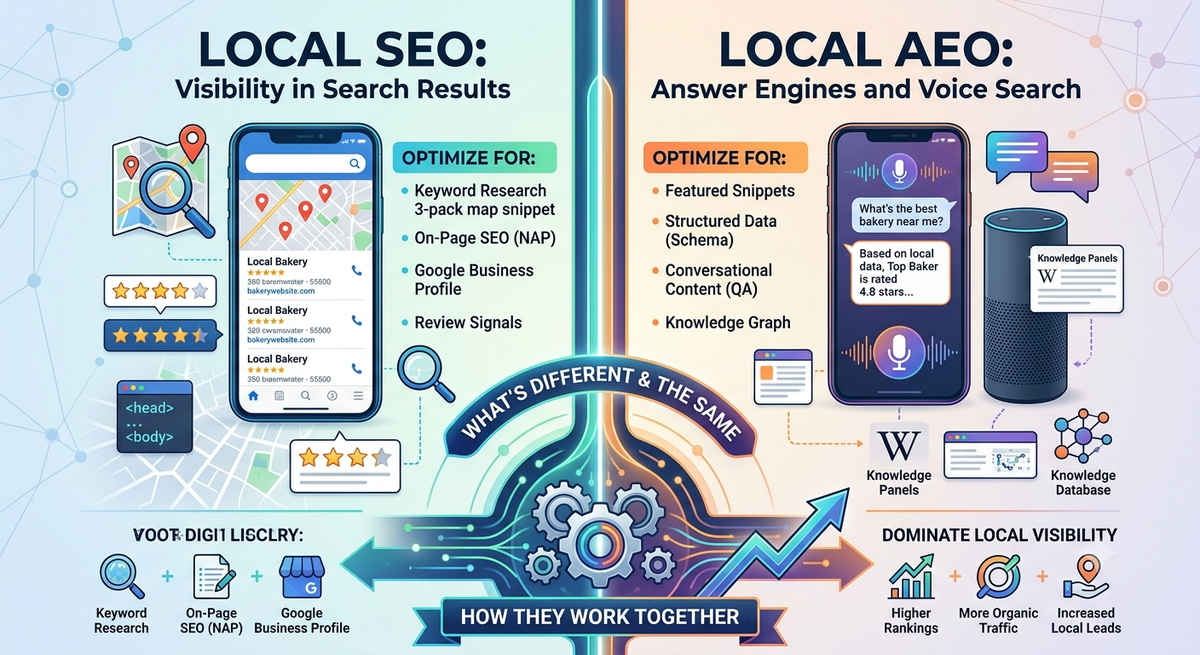
Local SEO optimises for an index. The search engine catalogs your website and GBP, matches keywords to queries, and presents a list of options. The user chooses.
Local AEO optimises for a model. The AI engine reads, synthesises, and selects. It doesn't show a list of plumbers. It says: this plumber, for this situation, right now. The user doesn't choose — the AI already chose.
That shift changes everything about how you structure your content, your profiles, and your proof.
With local SEO, a fragmented query like "dental clinic Chennai" triggers a ranked list. The user clicks. With local AEO, a conversational query like "which dental clinic near me is open on Sundays and handles nervous patients well" expects one answer. The AI scans structured data, review sentiment, and schema markup across the web and produces a recommendation.
Ask Maps doesn't care about your ranking. It cares about understanding. If your business data is ambiguous, inconsistent, or missing scenario-specific content, the model passes you over. It picks the business it can read cleanly.
The attribution model also changes. Local SEO success is a click. Local AEO success is citation ownership — being the entity the AI explicitly names as its source. That's a fundamentally different game, requiring a different kind of content architecture.
What Local SEO and Local AEO Share
You can't have a successful local AEO strategy without a solid local SEO foundation. The two share the same core assets.
Google Business Profile is the anchor for both. Verified hours, accurate categories, service attributes, and active posting all feed standard Google Maps rankings and AI Overviews simultaneously. An out-of-date GBP is a problem for your local pack position AND your AI citation chances.
Reviews matter to both — differently. Local SEO uses review volume and recency as ranking signals. Local AEO models read the language inside reviews to answer subjective queries. A user asking "find a quiet café near me for a business meeting" gets their answer from what reviewers actually wrote, not from star ratings alone. High-quality, text-rich reviews serve both systems at once.
Local relevance signals are shared infrastructure. Geo-targeted landing pages, localized content, backlinks from local organisations — these prove to both a traditional search index and an AI model that your business genuinely operates in a specific area. You build these once. They work twice.
NAP consistency is table stakes for both. Your business name, address, and phone number must match exactly across your website, GBP, Yelp, Apple Maps, and every directory. For local SEO, inconsistency hurts rankings. For local AEO, it lowers the AI's trust score and triggers omission. A classic local SEO cleanup directly improves your AI visibility.
Your customers are asking questions. Are you in the answer? If your foundational data is inconsistent or thin, the answer is no — for both algorithms.
How They Complement Each Other
Think of local SEO and local AEO as an assembly line. Local SEO builds raw visibility and authority. Local AEO structures and translates that authority so AI engines can digest and recommend it.
Here's the flywheel in practice:
Schema markup serves both systems. When you add LocalBusiness, FAQPage, or Product schema for SEO purposes, you're handing AI engines clean, pre-parsed data. They pull facts, availability, and service specifics directly from that markup into conversational answers. One implementation, two payoffs.
Answer-first content ranks and gets cited. A strong local SEO strategy involves localized blog posts, FAQ pages, and service landing pages targeting long-tail queries. When those pages are structured with a direct 40-word answer at the top before the detail, they do double duty. They rank in standard results and get lifted by AI models as the direct response to a voice or chat query.
Reviews build both ranking signals and AI trust. Review volume and recency improve your local pack position. The language in those reviews gives AI engines the scenario-specific proof they need to cite you for contextual queries. Both systems read the same reviews — but for different things.
For a real-world example: a user asks Gemini, "What's the best HVAC company near me that handles emergency furnace repairs?" Local SEO ensures the company's website ranks for "emergency HVAC repair" and that its GBP is active. Local AEO ensures there's an explicit paragraph on the site stating the company provides emergency furnace repairs in [city], backed by schema markup the AI can extract without guessing. Paigent for HVAC & Plumbing is built around exactly this kind of scenario-specific, Gemini-readable content structure.
How Paigent Automates Local AEO for Multi-Location Brands
This is where the theory meets the operational gap. Most multi-location businesses — salons, cleaning services, real estate teams, general contractors — have a brand-level website and one GBP strategy applied across all branches. That's a local SEO approach. It's not enough for Ask Maps.
Ask Maps picks one winner per local search. And each location competes independently. A branch in one suburb needs its own proof, its own structured content, its own AI-readable signals. Brand AEO ≠ Local AEO. One central strategy doesn't make 10 locations visible. Each location must rank independently.
Here's how Paigent delivers local AEO for every branch:
- Connect your Google Business Profiles. Link each branch's GBP to Paigent. The platform reads existing reviews, service data, and location attributes as the raw material for content generation.
- Generate branch-specific, Gemini-readable content. Paigent auto-generates AEO-optimized blog posts and landing pages for each location — structured with direct answers, LocalBusiness schema, and scenario-specific language that AI engines can extract and cite.
- Collect new reviews at scale. The 77-language voice and text review collection tool gathers reviews from customers in their own language, building the text-rich proof AI models read for contextual recommendations.
- Convert reviews into social proof. The Review to Post solution turns Google reviews into Instagram posts and Reels in 60 seconds — feeding both social signals and fresh content back into the visibility loop.
- Publish and repeat at scale. Every location gets fresh, on-brand, branch-specific content continuously. One central brand voice. Branch-specific content automatically. No marketing team required.
- Monitor Ask Maps performance. Track which branches are appearing in Google's 3–8 Ask Maps recommendations per query and where gaps remain, adjusting content signals as needed.
Setup takes 1–2 weeks. First Ask Maps results typically appear in 4–8 weeks. Not instant — but systematic. For a deeper look at whether your current AEO content is generating visible results, Is Your AEO Blog Actually Working? Here's How to Tell is worth reading alongside this post.
Why Choose Paigent
Paigent automates Ask Maps visibility for every branch without requiring a marketing team. That's not a general claim. Here's what it means specifically:
Paigent generates branch-specific, Gemini-readable content at scale. Each branch gets its own AEO-optimized pages — not one template applied everywhere. Google sees coherence. Coherence = visibility. Each location ranks independently in Google Ask Maps' 3–8 recommendations.
The review infrastructure runs in 77 languages. Voice and text. One tap. That means a Vietnamese-speaking customer at your salon or a Spanish-speaking homeowner booking your cleaning service can leave a review in their language — and that review feeds your AI trust score the same as any English-language review. Turn your happiest customers into your best marketing.
Pricing is built for operators, not agencies. The Starter Plan starts at $9/month for up to 2 locations, the Growth Plan at $19/month for 5 locations, and the Pro Plan at $39/month for up to 15 locations. Every plan includes a 14-day free trial, no credit card required. Full refund available within 14 days of purchase, provided you haven't downloaded any generated content. Cancel anytime.
Multi-location service brands — salons, real estate teams, cleaning services, and more — are the exact use case Paigent is built for. One central brand voice, branch-specific content automatically.
Who Paigent Is Best For — and Who Might Consider an Alternative
Paigent is best suited for multi-location service businesses with 3 or more branches whose customers search locally. If you run a salon group, a dental chain, an HVAC operation, a pest control franchise, or a cleaning service across multiple neighbourhoods, and you don't have a dedicated marketing team — this is built for you. The automation handles what a marketing manager would normally own, and it does it at branch-specific scale.
If you mainly need results in 30 days or less, a different approach may fit better. Paigent's first Ask Maps results appear in 4–8 weeks. The system builds durable, AI-readable authority — it's not a paid ads tool.
If you prefer to control every piece of content before it publishes, Paigent is an automated system, not a done-for-you agency with manual approval workflows. Operators who want hands-on editorial control over every post will find the automation model a constraint.
Single-location businesses and online-only businesses without a Google Business Profile are outside the designed use case entirely. The platform's branch-specific content engine requires at minimum 3 locations to work as designed.
If walk-in traffic and local search visibility aren't business priorities for you, the core value proposition doesn't apply.
Start with the right fit. Paigent works well when the conditions match — and it's honest about when they don't.
---
If your business has multiple locations and your branches aren't showing up when customers ask AI assistants for local recommendations, visit getpaigent.com to start your 14-day free trial — no credit card required — and see which of your locations are winning Ask Maps and which ones aren't yet.
Frequently Asked Questions
What is the difference between local SEO and local AEO for a multi-location business?
Local SEO gets each branch into a ranked list in Google Maps or standard search results by matching keywords. Local AEO gets each branch cited directly by AI engines like Gemini or ChatGPT when a customer asks a conversational question. Both matter — but they target different algorithms and require different content structures. Multi-location brands need both strategies running simultaneously to cover the full range of local search behaviour in 2026.
Does fixing local SEO automatically improve Ask Maps visibility?
Not automatically. A clean Google Business Profile and NAP consistency across directories improve your AI trust score — so local SEO work does feed local AEO. But AI engines also require scenario-specific, structured content with schema markup to cite your business in a direct answer. Ranking in the Local 3-Pack doesn't guarantee Ask Maps recommendations; those require additional Gemini-readable, answer-first content at the branch level.
How does Paigent generate branch-specific content for Ask Maps?
Paigent connects to each location's Google Business Profile, reads existing reviews and service data, then auto-generates AEO-optimized blog posts and landing pages tailored to that specific branch. Each page is structured with LocalBusiness schema and direct-answer formatting that AI engines can extract. The system runs continuously, so every location gets fresh content without requiring a marketing team to produce it manually.
Why does Ask Maps show so few businesses per query, and how do I make sure my branch appears?
Ask Maps returns 3–8 businesses per query — not a full ranked list. The AI selects businesses it can read clearly: structured data, scenario-specific content, consistent GBP information, and text-rich reviews that match the conversational query. To appear, each branch needs its own AI-readable proof: explicit service descriptions, schema markup, and review language that aligns with the kinds of questions customers are actually asking.
What role do Google reviews play in local AEO vs. local SEO?
In local SEO, reviews function as a ranking signal — volume and recency affect your position in the Local Pack. In local AEO, AI models read the actual language inside reviews to answer subjective queries like "find a salon that reviewers say is good for curly hair." The same reviews serve both systems, but for different reasons. Building a consistent flow of text-rich reviews strengthens both your map ranking and your AI citation potential at the same time.
Can a business with multiple locations run local SEO and local AEO from a single strategy?
Not effectively with a single brand-level strategy. Local SEO can be managed at a brand level to some degree. Local AEO requires branch-specific content authority — each location needs its own structured pages, its own GBP signals, and its own scenario-specific proof. Brand AEO ≠ Local AEO. A branch in one suburb competes in a different Ask Maps context than a branch two suburbs away, so each location must rank independently.
How long does it take to see Ask Maps results after starting local AEO work?
With Paigent, setup takes 1–2 weeks and first Ask Maps results typically appear within 4–8 weeks. Local AEO builds durable, AI-readable authority over time rather than delivering overnight visibility. The timeline reflects how AI engines accumulate and verify trust signals across a business's web presence — GBP data, structured content, reviews, and schema — before confidently citing a specific branch in a conversational answer.