Can an AI Platform Guarantee Top HVAC Rankings in Google Ask Maps?
Learn how Ask Maps visibility works for HVAC and plumbing contractors, why 78% of branches are invisible, and what AI platforms can realistically deliver for local rankings.

Google's Ask Maps feature doesn't work like traditional local search. It surfaces 3–8 businesses per query in a conversational recommendation layer, and the signals it uses to pick those businesses are different from the ones that drive blue-link rankings. This post explains how Ask Maps visibility actually works for HVAC and plumbing contractors, what the data shows about how badly most branches are currently missing from those results, and where AI-driven platforms fit into a realistic improvement strategy.
Key Takeaways
- Ask Maps shows just 3–8 businesses per query (Search Engine Land, April 2026), making it far more competitive than a standard local pack or directory listing.
- 78% of local service brands are invisible to Ask Maps (5W AI Visibility Index, 2026), meaning most HVAC and plumbing branches have a real, measurable gap to close.
- Only 1.2% of local HVAC branches are cited by ChatGPT for contractor queries (Marketing Code, 2026), confirming how severe AI citation fragmentation is across the trade services category.
- Franchise networks punch far above their weight — Roto-Rooter, ARS/Rescue Rooter, and Mr. Rooter together account for an estimated 19% of all HVAC and plumbing consumer-intent AI citations, despite those three brands representing a fraction of actual U.S. contractors.
- Paigent targets the #1–2 position per branch in Ask Maps answers by generating Gemini-readable content, publishing LocalBusiness, FAQPage, and Review JSON-LD schema per location, and syncing with Google Business Profile daily.
- First Ask Maps visibility lift typically appears in 4–8 weeks, with 12 branches deployable in as little as 2 weeks — timelines that reflect the platform's automated, multi-location build process.
What Ask Maps Is — and Why It's Different from SEO
Ask Maps is the conversational recommendation layer inside Google Maps. When a user types or speaks "best HVAC company near me" or "plumber open on Sunday," Ask Maps doesn't return a ranked list of links. It reads available structured data and generates a recommendation, naming specific businesses directly.
That matters for one reason above all others: more than 50% of all Google searches in the U.S. end without a single click, according to SparkToro and Datos research from 2024. If Ask Maps recommends your branch by name, the customer may never visit your website — they call, they book, they show up. If Ask Maps doesn't name you, no amount of organic ranking catches that customer.
The ranking signals Ask Maps uses are fundamentally different from traditional SEO. It cares about structured schema, coherent branch-level content, and machine-readable proof of what a location does and where it operates. A well-optimized website with strong domain authority can sit at position one in organic search and be completely absent from the Ask Maps answer.
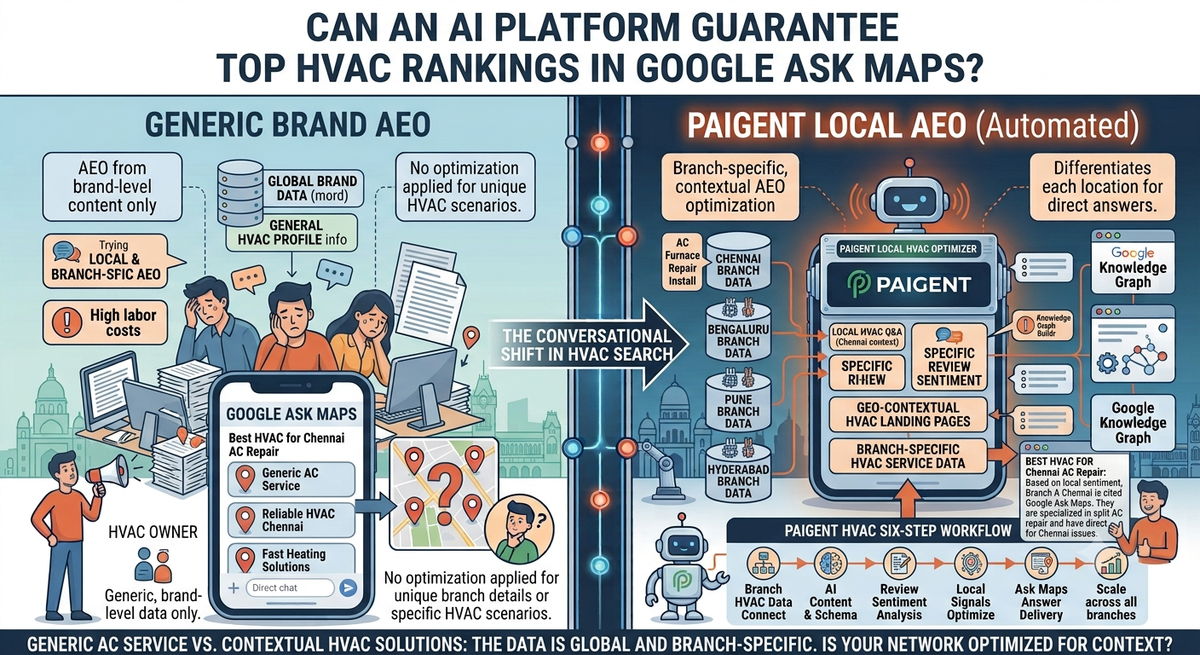
That's Brand AEO vs. Local AEO. Brand AEO builds authority for the company as a whole. Local AEO builds citation-worthy content for each specific branch, so Ask Maps can surface the right location for the right query. For multi-location HVAC and plumbing operators, the distinction is critical. Each branch needs its own profile, its own schema, its own service-level content. One brand-level strategy does not cover 8 locations.
The Visibility Gap Facing HVAC and Plumbing Contractors
The numbers are stark. A Local Vitals study of 746 AI queries for HVAC services across Florida found that 96.9% of HVAC companies appeared on only one of five AI platforms tested — the worst fragmentation result of any industry in the study. That's not a marketing problem. That's a content infrastructure problem.
Ask Maps surfaces 3–8 recommendations per query. Those slots tend to go to businesses with three things: complete, structured GBP data; schema markup that tells Gemini exactly what each location offers; and consistent, fresh signals like recent reviews and updated service content. Most independent HVAC and plumbing branches have none of the three in place at the branch level.
Franchise networks have recognised this. Collectively, franchise networks appear in approximately 25–30% of 'service near me' trade prompts despite representing well under 5% of actual U.S. contractors. Their advantage isn't brand strength alone. It's that franchises have invested in branch-level structured content at scale — the exact input Ask Maps needs.
Independent multi-location operators can close that gap. But doing it manually, branch by branch, requires creating and maintaining four content types per location: a branch profile, service pages, FAQ schema, and review proof. Multiply that across 8 or 12 locations and it becomes a full-time job. The operators currently invisible in Ask Maps aren't underperforming — they're under-resourced.
How Branch-Level Ask Maps Optimization Actually Works
For a branch to appear in Ask Maps recommendations, the optimization process needs to address each layer the algorithm checks. Here's what that looks like in practice, and how Paigent for HVAC & Plumbing structures the deployment:
- Audit each branch's current Ask Maps score. Before generating content, the platform checks where each location currently stands: is it visible at all? What schema is missing? Is the GBP data complete and consistent? This is the baseline every branch starts from.
- Generate branch-specific Gemini-readable content. Each location gets its own profile, service pages, and FAQ content written for Ask Maps' interpretation layer, not for human browsers. Gemini needs machine-readable proof. Generic brand-level copy doesn't qualify.
- Deploy LocalBusiness, FAQPage, and Review JSON-LD schema. Schema is what tells Google exactly what each branch is, what it offers, and where it operates. Without it, Ask Maps has to guess. With it, each location ranks independently.
- Sync daily with Google Business Profile. The platform maintains a daily GBP sync so that business hours, services, and contact data stay accurate across all locations. Stale data signals low credibility to Ask Maps.
- Refresh content weekly. A weekly content cycle — updated FAQs, new review proof, refreshed service content — tells Gemini the branch is active and authoritative. Google sees coherence. Coherence = visibility.
- Monitor and iterate per branch. Ask Maps visibility lifts at the branch level independently. Some locations will rise faster based on local competition and existing GBP data. The system tracks each one separately.
You can also check your current Ask Maps score before committing to any platform — understanding your baseline is the right starting point.
Can Any Platform Guarantee a #1 Ask Maps Ranking?
Honest answer: no platform can guarantee a specific rank. Google controls Ask Maps, and its recommendation algorithm changes. What a well-built platform can do is close the gap between where your branches are now (invisible) and where they need to be (structured, schema-complete, actively maintained).
The visibility shift Paigent targets — from #0 to #1–2 per branch — is achievable because most HVAC and plumbing branches start from a near-zero baseline. They have no LocalBusiness schema. No FAQ schema. No branch-level content that Gemini can read and cite. When those elements are in place, the branch becomes eligible for the 3–8 recommendation slots that were previously unreachable.
The timeline matters here. First Ask Maps visibility lift appears in 4–8 weeks, not 4–8 days. The reason is that Ask Maps needs time to crawl updated schema, recrawl GBP data, and recalibrate its recommendation model for each location. That's the honest expectation. If a vendor promises top rankings by next Tuesday, the claim is not grounded in how the algorithm works.
What changes immediately after deployment is the foundation: schema is live, content is indexed, GBP is syncing daily. The ranking shift follows. That sequence is reliable. The exact position any one branch lands is not guaranteed — it depends on local competition, review volume, and query specificity.
Where Paigent Fits
Paigent is built specifically for multi-location HVAC and plumbing operators with 3 or more branches, no dedicated marketing team, and customers who search locally. The platform automates the four content types every branch needs — profile, services, FAQ, and review proof — and deploys them with the LocalBusiness, FAQPage, and Review JSON-LD schema that Ask Maps requires. Twelve branches can be live in 2 weeks.
It is not a done-for-you agency. It's not a manual content tool. If you want to approve every sentence before it publishes, or if your business runs from a single location, this isn't the right fit.
For HVAC and plumbing operators with 3+ locations who want to automate Ask Maps visibility without hiring a marketing team, the Check Ask Maps Score tool is the right place to start — it shows exactly where each branch stands before any commitment is made.
The 14-day free trial requires no credit card. It's a reasonable first step for any multi-location operator who suspects their branches are part of the 78% Ask Maps can't see.
Who Ask Maps Optimization Is Best For — and Who Should Consider an Alternative
Ask Maps visibility automation is well-suited to specific operators. Getting clear on fit before investing time or budget saves both.
Best suited for:
- Multi-location HVAC and plumbing brands (3+ branches) whose customers search "HVAC near me" or "emergency plumber near me" and expect a named recommendation, not a list of links.
- Operators without a marketing team who need branch-level content maintained automatically, not manually.
- Brands currently invisible in Ask Maps — the 78% with no LocalBusiness schema, no FAQ markup, and no branch-specific content that Gemini can read.
Consider an alternative if:
- You have a single location. Ask Maps optimization is a per-branch process, and Paigent requires a minimum of 3 locations to deploy.
- You need results in 30 days. The first Ask Maps visibility lift takes 4–8 weeks. That timeline reflects how the algorithm updates, not a platform limitation.
- You want manual control over every content decision. Paigent's system is automated by design. Operators who prefer to review and approve each piece before publication will find that friction-heavy.
- You're an online-only business with no Google Business Profile. GBP data is the foundation the entire system syncs from — no GBP means no basis to optimize.
The right fit question is simple: do you have 3+ branches, local customers who search conversationally, and a visibility gap in Ask Maps right now? If yes, the automation model makes sense. If not, a different tool or a manual AEO strategy may be more appropriate.
If you're a multi-location HVAC or plumbing operator and you're not sure where your branches stand in Ask Maps today, check your Ask Maps score — it's a free diagnostic with no commitment required.
Frequently Asked Questions
What is the difference between Ask Maps visibility and traditional local SEO for HVAC companies?
Traditional local SEO targets blue-link rankings in Google Search — the positions users see before clicking to a website. Ask Maps visibility targets the conversational recommendation layer inside Google Maps, where the engine names 3–8 specific businesses directly. Ask Maps reads structured schema, branch-level content, and GBP signals — not domain authority or link profiles. A business can rank well in organic search and be entirely absent from Ask Maps recommendations.
How does AI-generated schema markup help an HVAC or plumbing branch appear in Ask Maps?
Ask Maps uses structured data — specifically LocalBusiness, FAQPage, and Review JSON-LD schema — to understand what a business offers and where it operates. Without schema, Ask Maps has to infer these details from incomplete signals, which typically means the branch is skipped. Deploying accurate schema per branch gives the algorithm machine-readable confirmation of services, location, and credibility, directly increasing the branch's eligibility for the 3–8 recommendation slots.
Why do franchise HVAC networks appear in AI recommendations more often than independent operators?
According to the 5W AI Visibility Index 2026, franchise networks appear in approximately 25–30% of 'service near me' trade prompts despite representing well under 5% of actual U.S. contractors. Their advantage is structured, branch-level content deployed at scale — the same input Ask Maps requires. Most independent multi-location operators have not built this infrastructure per branch, which is why 78% of local service brands remain invisible to Ask Maps.
How long does it realistically take to see results in Ask Maps after optimizing a branch?
After deploying schema, branch-specific content, and a daily GBP sync, first Ask Maps visibility lift typically appears in 4–8 weeks. Ask Maps needs time to crawl updated schema, re-index GBP data, and recalibrate its recommendation model. The content infrastructure is live immediately after setup, but the ranking shift follows the algorithm's own recrawl cycle. Operators expecting results in under 30 days should adjust their timeline expectations before investing in any optimization platform.
What content does each HVAC or plumbing branch need to rank independently in Ask Maps?
Each branch needs four content types to be citation-eligible in Ask Maps: a branch profile specific to that location, service pages describing what that branch offers, FAQ content written for Gemini's interpretation layer, and review proof that signals credibility. These need to be maintained actively — not published once and forgotten. A daily GBP sync and weekly content refresh cycle keep the branch appearing current and authoritative to Ask Maps' recommendation algorithm.
Is Ask Maps optimization relevant for plumbing businesses, or mainly for HVAC?
Both categories face the same visibility problem. The 1.2% AI citation rate for local HVAC branches (Marketing Code, 2026) and the 96.9% single-platform fragmentation rate found in the Local Vitals study apply to trade services broadly — HVAC and plumbing share the same Ask Maps recommendation environment. Both search intents ("plumber near me," "HVAC repair near me") surface in conversational queries that Ask Maps answers with 3–8 named businesses. The optimization inputs — schema, branch content, GBP sync — are identical for both.
What's the minimum branch count needed to make Ask Maps optimization cost-effective for a trade services business?
The automation model for Ask Maps optimization is designed for multi-location operators with 3 or more branches. Below that threshold, the per-branch content infrastructure can often be managed manually without a dedicated platform. At 3 or more locations, maintaining branch-specific schema, content, and GBP data manually becomes operationally difficult without a marketing team — which is where automated platforms start to deliver meaningful time and cost efficiency relative to the manual alternative.