How Much Can Ask Maps Visibility Actually Increase a Salon's Annual Revenue?
Paigent projects $50K–$100K annual revenue increase per salon from Ask Maps visibility. See the booking math, setup timeline, and how branch-specific content drives results.

If your salon isn't showing up in Ask Maps answers, you're not just losing a few clicks — you're losing bookings to the handful of competitors that are. Ask Maps shows only 3–8 businesses per query, and according to the 5W AI Visibility Index (2026), 78% of local service brands are currently invisible to it. Paigent's data for salons projects $50K–$100K in additional annual revenue per location for salons that close that visibility gap. This post breaks down where that number comes from, what drives it, and whether the math holds for your business.
Key Takeaways
- Ask Maps is a winner-takes-most surface. Google surfaces only 3–8 businesses per local query — not a page of results. If your salon isn't in that set, you're invisible.
- 78% of local service brands don't appear in Ask Maps answers today, according to the 5W AI Visibility Index (2026) — which means most salons are leaving revenue on the table.
- Paigent projects $50K–$100K in additional annual revenue per salon location from Ask Maps visibility, based on 8–12 incremental walk-in bookings per month.
- Each location ranks independently — Paigent generates branch-specific, Gemini-readable content so each of your salons competes in its own local Ask Maps results.
- First Ask Maps lift appears in 4–8 weeks, with setup taking 1–2 weeks. Not instant — but structured and predictable.
- 14-day free trial, no credit card required — the platform is built so you can verify the approach before committing.
The Revenue Math: Where Does $50K–$100K Come From?
Start with what we know about salon economics. The average hair salon revenue for employer establishments is approximately $321,000 per year, based on Census and FRED data. An incremental $50K–$100K on top of that baseline represents a 15–30% revenue increase per location.
Paigent's projection anchors to 8–12 additional walk-in bookings per month from Ask Maps. Run the numbers yourself: if a new booking averages $80–$120 in service value, with a reasonable re-booking rate, that monthly increment compounds quickly across a year.
There's external support for why Ask Maps visibility moves the needle this hard. Businesses appearing in the Google Maps 3-pack receive 126% more traffic and 93% more actions than those ranking 4–10. Ask Maps is the AI-native evolution of that 3-pack. Winning one of those 3–8 recommendation slots puts your salon in front of customers who have already expressed intent — they're asking "best balayage salon near me" and Google is picking the answer for them.
No documentation of the ROI methodology behind the $50K–$100K figure has been provided, so treat it as a directional projection rather than a guaranteed outcome. That said, the underlying booking math is transparent and replicable.
Why Most Salons Are Invisible to Ask Maps Right Now
This is the gap most salon owners don't know exists. Traditional SEO targets the blue-link results page. Ask Maps — Google's AI-powered conversational layer inside Google Maps — operates differently.
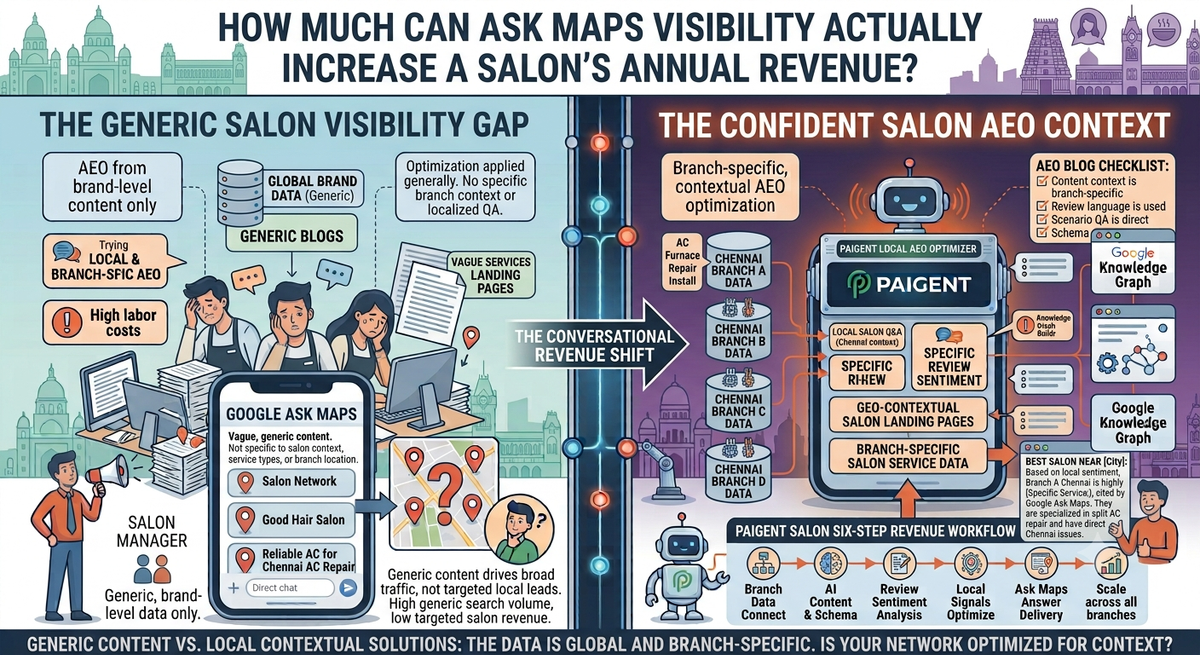
Ask Maps doesn't rank websites. It recommends businesses based on structured signals: schema markup, Google Business Profile coherence, branch-specific content authority, and review density. Brand AEO ≠ Local AEO. A strong national brand presence does nothing for your Midtown location if that specific branch lacks the structured data and content signals Ask Maps needs to understand it.
Your branch wasn't mentioned in Ask Maps answers not because your salon is bad — it's because Google doesn't have enough coherent, structured information about that specific location to confidently recommend it. Daily GBP sync matters here. So does deploying LocalBusiness, FAQPage, and Review JSON-LD schema. These aren't SEO tricks. They're the signals Ask Maps uses to verify that your branch is real, active, and relevant to the query.
The content gap is also real at scale. A salon group with 10 locations needs 10 distinct branch-specific content sets to rank independently. That's not a task for a marketing team of one, or zero.
How Paigent for Salons Delivers Ask Maps Visibility
This is the specific process Paigent runs for multi-location salon operators.
- Onboarding and GBP connection — Paigent connects to your existing Google Business Profile setup. No changes to your current review process required. Profiles are verified and synced on a daily basis.
- Branch-specific content generation — Using Claude Haiku AI, Paigent generates four content types per salon location: a salon profile, a services page, FAQ content, and review proof. Each piece is Gemini-readable and structured for Ask Maps extraction.
- Schema deployment — LocalBusiness, FAQPage, and Review JSON-LD schema are deployed across every location. Google sees coherence. Coherence equals visibility.
- Review collection activation — Paigent's 77-language voice and text review collection system activates for each branch, pulling Google Maps reviews via Apify to continuously strengthen location signals.
- Weekly content refresh — Content is refreshed weekly to maintain freshness signals, while the GBP sync runs daily. Reviews are also turned into Instagram posts and Reels in 60 seconds — so your Ask Maps content strategy feeds your social presence automatically.
- Ask Maps lift tracking — First Ask Maps results appear in 4–8 weeks. Paigent's visibility target is a #1–2 position in Ask Maps answers for each branch's core service queries.
Need a sense of rollout speed? Eight salons have been deployed live in a single week. If you're running 10–20 locations and worried about implementation drag, that number is relevant. More on rollout timelines in How Fast Can an Ask Maps Visibility Platform Get Multiple Branches Live?
Why Choose Paigent
Paigent automates Ask Maps visibility for every branch without a marketing team. That's not a positioning statement — it's the operational design of the platform.
Each location ranks independently in Google Ask Maps' 3–8 recommendations because Paigent generates branch-specific, Gemini-readable content at scale. One central brand voice. Branch-specific content automatically. The alternative is manually producing and maintaining structured content for every location — which is why most multi-location salon groups have nothing in Ask Maps right now.
The trial is 14 days free, no credit card required. Setup takes 1–2 weeks, and the first Ask Maps results appear in 4–8 weeks. Paigent also turns Google reviews into Instagram posts and Reels in 60 seconds and supports review collection in 77 languages — so the platform earns its keep beyond Ask Maps alone.
For salons across the same verticals — dental, HVAC, real estate — the same infrastructure applies. See Paigent for Dental Clinics and Paigent for HVAC & Plumbing for how the same branch-level approach works across service categories.
Who Paigent Is Best For — and Who Might Consider an Alternative
Paigent for Salons is built for multi-location salon operators with 3 or more branches whose clients search "best [service] near me" and who don't have a dedicated marketing team running local SEO. If you fit that profile, the platform is designed precisely for your operational constraints.
Consider an alternative if:
- You have one location. Paigent requires a minimum of 3 branches. Single-location salons aren't the target use case.
- You need results within 30 days. First Ask Maps lift takes 4–8 weeks. If the timeline is harder than that, this isn't the right fit right now.
- You want to manually control every detail. Paigent is an automated system. It's not a done-for-you agency and it's not a manual content tool. If you want hands-on editorial control over every post and profile update, that's not what this does.
- Your business is online-only. Ask Maps is a local, physical-presence surface. Without a Google Business Profile and walk-in traffic relevance, there's no Ask Maps visibility to win.
If you're running 5–20 salon locations and losing bookings to competitors who show up in Ask Maps answers — that's the problem Paigent is built to fix.
Your Customers Are Already Asking. Are You in the Answer?
89% of local searches now happen as conversations in Google Maps. 80% of Americans search online weekly for local service providers. Ask Maps picks one winner per local search — usually from a pool of 3–8 businesses. Right now, 78% of salons aren't in that pool at all.
The revenue projection of $50K–$100K per location is directional. The mechanism is not. More Ask Maps appearances mean more walk-in intent, more bookings, and compounding re-booking revenue over a year. The math is straightforward once visibility is established.
Start your 14-day free trial at Paigent — no credit card required. If your salon group has 3 or more locations and you're ready to win local AI visibility on autopilot, check your Ask Maps score to see where your branches stand today.
Frequently Asked Questions
How does Ask Maps visibility translate into actual salon revenue?
Ask Maps shows only 3–8 local businesses per query. Salons that appear in those slots receive high-intent walk-in traffic from customers who have already decided to book. Paigent projects 8–12 incremental walk-in bookings per month per location from Ask Maps visibility, which compounds into $50K–$100K in additional annual revenue per salon at typical service values — though outcomes depend on location, pricing, and re-booking rates.
How long does it take for a salon to appear in Ask Maps after setup?
Setup takes 1–2 weeks. First Ask Maps lift — meaning your salon branch begins appearing in Ask Maps answers for relevant local queries — typically occurs within 4–8 weeks of going live. This timeline reflects how quickly Google's answer engine processes new structured data, schema signals, and content coherence from the branch-specific profile Paigent generates.
What content does Paigent generate for each salon location?
Paigent generates four content types per branch: a salon profile, a services page, FAQ content, and review proof. Each piece is structured with LocalBusiness, FAQPage, and Review JSON-LD schema, making it readable by Google's Gemini engine. Content refreshes weekly, and the Google Business Profile syncs daily to maintain freshness signals for Ask Maps ranking.
Can a salon group with multiple locations get all branches live quickly?
Rollout is designed for speed at scale. Paigent has deployed 8 salons live within a single week. For groups with 10–20 locations, the platform generates branch-specific content in parallel, so you're not waiting weeks per location. Each branch gets its own Ask Maps-optimized content set so it can rank independently in its local search area.
Does a salon need to change its existing review collection process to use Paigent?
No. Paigent integrates with your existing Google review setup — it doesn't replace it. Reviews are collected via Google Maps and fed into Paigent's content system, which also converts them into Instagram posts and Reels in 60 seconds. Review collection supports 77 languages via voice and text, which is useful for salons serving multilingual communities.
Is Ask Maps visibility the same as traditional local SEO for salons?
No. Traditional local SEO targets the blue-link results page. Ask Maps is the AI-powered conversational layer inside Google Maps — it recommends businesses based on structured data, GBP coherence, and content authority rather than backlink profiles or keyword density. Brand AEO (Answer Engine Optimization) operates at the brand level; Local AEO is branch-specific. Winning Ask Maps requires branch-level content signals, not brand-level strategy alone.
What salon operators is Paigent not suited for?
Paigent requires a minimum of 3 locations, so single-location salons are outside its scope. It's also not suited for salons that need results faster than 4–8 weeks, want manual editorial control over every content update, or don't rely on walk-in traffic. It's an automated visibility platform — not a marketing agency and not a manual content tool. Salon groups that match the multi-location, locally-searched profile get the most from it.