What Is a Local AI Visibility Platform — And Why Multi-Location Brands Need One
Learn what a Local AI Visibility Platform is, how Ask Maps selects its 3–8 recommendations, and why multi-location brands need branch-specific proof to win local AI search.

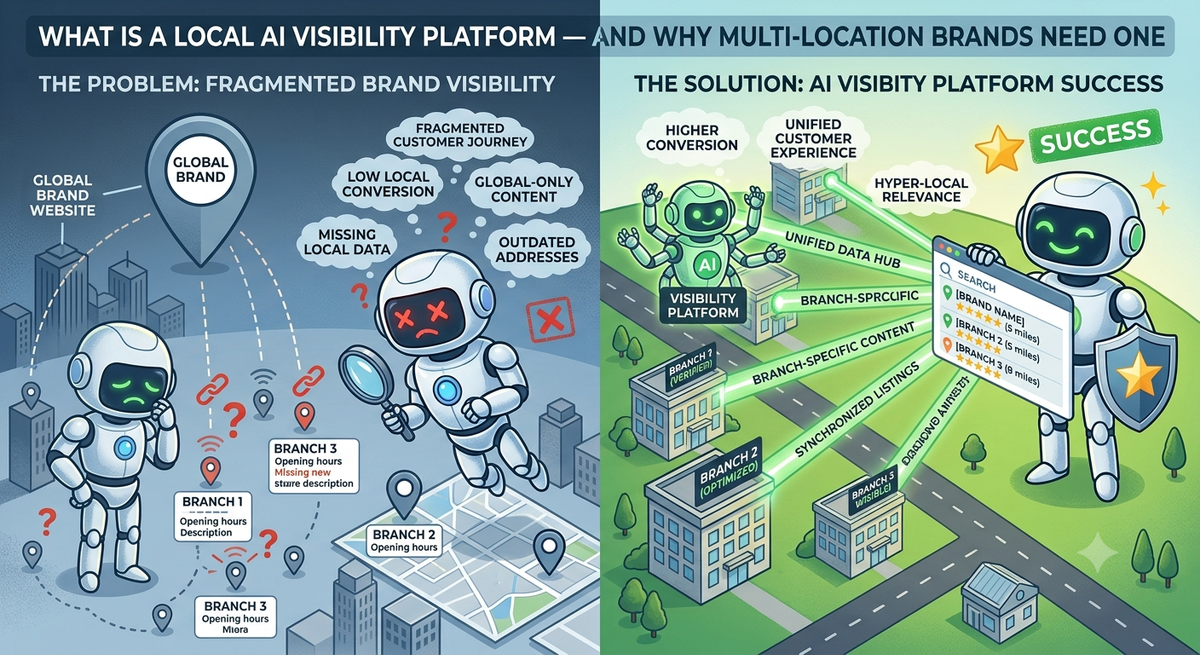
When someone types "best HVAC repair near me" into Google Maps today, they don't get ten blue links. They get a short list of three to eight businesses, recommended directly by Ask Maps, and the conversation ends there. If your branch isn't named, it doesn't exist for that customer — it's that binary. This post explains what a Local AI Visibility Platform actually is, how Ask Maps decides who makes that list, and why the content strategy that built your national brand presence is structurally incapable of winning local AI search.
Key Takeaways
- Ask Maps shows 3–8 businesses per query — not a ranked page of results, a finite list that stops, so visibility here is all-or-nothing for each branch.
- 78% of local service brands are currently invisible to Ask Maps — the vast majority of multi-location businesses have no presence in the answer that matters most.
- Brand AEO ≠ Local AEO — centralized brand content builds national authority but cannot prove branch-level relevance; each location needs its own proof signals.
- Nearly half of all U.S. adults used an AI tool to find a local business in the past month (according to Yext's 2026 Consumer Search Behaviors Report, which surveyed 3,848 consumers globally).
- Branch-specific proof — location-tied reviews, FAQ schema, service pages, and GBP signals — is what Ask Maps reads to select its recommendations.
- Automation is the only viable path — writing branch-specific content for 10, 50, or 150 locations manually is not a strategy; it's a resource problem with no manual solution.
---
How Ask Maps Decides Who Gets Recommended
Ask Maps doesn't pick winners from a ranked list. It reads structured proof — and names the branches that have it.
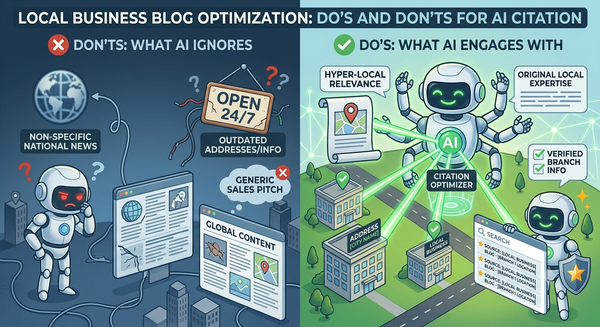
Google's Gemini model, which powers Ask Maps recommendations, evaluates branch-level signals: the completeness and freshness of your Google Business Profile, the presence of FAQ schema tied to that specific location, the volume and recency of reviews mentioning local service specifics, and whether your service pages demonstrate expertise for that exact market. These signals must be tied to each branch individually. Shared brand content doesn't carry a location signal strong enough to win a neighborhood query.
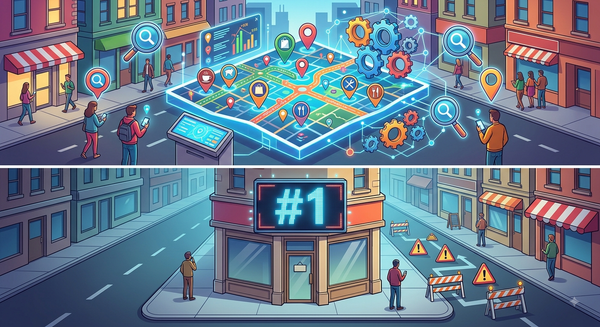
According to Search Engine Land (April 2026), Ask Maps shows 3–8 businesses per query. That constraint is the whole problem. In traditional search, ranking sixth still earns some clicks. In Ask Maps, position nine is the same as position ninety — you're not in the answer. The cutoff makes local AI visibility a winner-takes-most game, and the winners are whichever businesses have assembled the right branch-specific proof.
What counts as proof? Gemini is looking for coherence: a GBP profile that's current, service pages that mention the specific neighborhood and service type, FAQ content that mirrors the questions real customers ask, and reviews that confirm local expertise. When those signals stack together at the branch level, Ask Maps has enough evidence to include that location in its recommendation. When they're absent — or when the only content is a corporate homepage — it defaults to a competitor that has done the work.
The architecture matters here. This isn't a ranking algorithm you can game with backlinks. It's a trust model. Gemini is asking: does this branch actually serve this customer, in this neighborhood, for this specific need? Your national brand page cannot answer that question.
---
The Brand AEO vs. Local AEO Distinction — And Why It Matters
Most brands doing AEO (Answer Engine Optimisation) are optimising at the wrong level. Brand AEO builds entity authority — it helps Gemini understand what your company does, what it stands for, and where it operates nationally. That work is real and valuable. But it doesn't win local AI search.
Local AEO is a different problem. It requires branch-specific proof: content tied to a specific address, neighborhood, service type, and local customer intent. Consider the difference between these two queries:
| Query | What Ask Maps needs to recommend your branch |
|---|---|
| "best mortgage broker in Denver" | Content proving your Denver branch serves Denver borrowers — local market knowledge, Denver-specific FAQ schema, reviews mentioning Denver |
| "best sushi in Beverly Hills" | Content proving your Beverly Hills location serves that neighborhood's dining intent — cuisine specifics, occasion-specific FAQ, Beverly Hills reviews |
| "best pediatric dentist near me" | Clinic-specific service pages, pediatric FAQ schema, reviews confirming pediatric patients served |
| "HVAC repair near me at 2 AM" | Branch emergency service content, branch GBP updated with 24/7 hours, emergency-specific FAQ schema |
The through-line: every query is a local trust question, and Ask Maps is reading for branch-level evidence to answer it.
A centralized brand site can't supply that evidence at scale. It answers the brand trust question — "does this company exist and is it legitimate?" — but not the local relevance question. As covered in depth here, corporate websites structurally can't rank for branch-specific local searches because they lack the location-tied proof signals Ask Maps reads. Brand AEO and Local AEO require separate strategies, built on separate content architectures.
---
What a Local AI Visibility Platform Actually Does
A Local AI Visibility Platform is purpose-built infrastructure for closing the gap between brand-level content authority and branch-level Ask Maps presence.
At its core, it automates the creation and publication of branch-specific, Gemini-readable content — for every location in your network, at a scale that makes manual content work structurally irrelevant. Here's what that means in practice:
- Brand voice and business model setup. The platform learns how your brand communicates, which service categories you operate in, and what local intent signals matter for your industry. This happens once, at the brand level, and governs every branch's content going forward.
- Branch ingestion. Each location is added with its address, GBP data, and service area specifics. A network of 15 branches can be live in roughly three weeks; 25 branches in two. The platform handles the data identification work that makes each location distinct — not a copy of the corporate template.
- Local differentiation per branch. The AI identifies what makes each branch unique — its neighborhood, its specific service mix, the customer questions most relevant to its market — and generates content topics tailored to each location's actual competitive context.
- Content generation at scale. Branch profiles, service pages, FAQ schema (LocalBusiness, FAQPage, and Review JSON-LD), and review proof are generated per location. Each piece is written for local intent — meaning it answers the specific question a customer in that neighborhood would ask, not a generic company description. This is the branch-specific content approach that actually shifts Ask Maps recommendations.
- GBP sync and content publishing. Content publishes manually or on autopilot, with daily GBP sync and a weekly content refresh cycle. Gemini reads GBP freshness as a trust signal — stale profiles lose ground to competitors who are consistently publishing.
- Ask Maps scoring and iteration. Real-time Ask Maps scoring shows where each branch ranks in its local AI search, which queries it's winning, and where content gaps remain. The loop is self-correcting: new branch signals improve the content model over time.
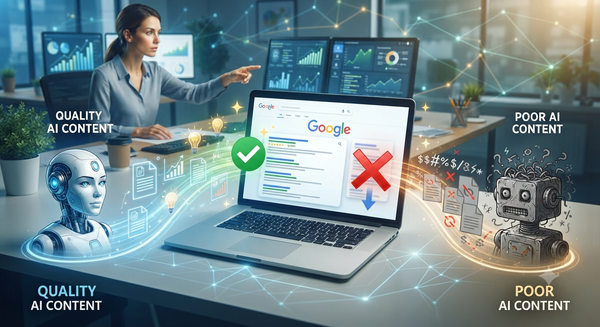
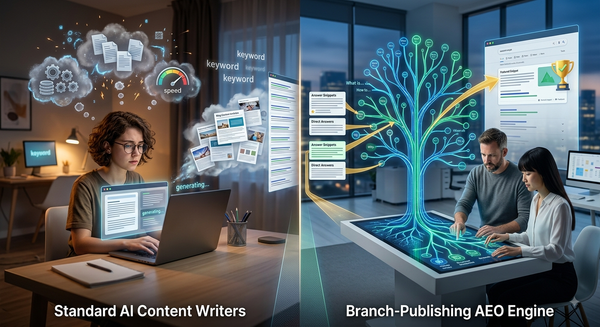
The critical difference between this workflow and generic content automation is specificity. Generic tools produce content. A Local AI Visibility Platform produces branch-specific proof — the kind of neighborhood-level, intent-matched content that Ask Maps uses to decide who gets recommended.
---
Why 78% of Local Brands Are Invisible — The Scale Problem
The invisibility rate isn't a mystery. It's arithmetic.
According to the 5W AI Visibility Index (2026), 78% of local service brands are invisible to Ask Maps. That figure reflects the reality that most multi-location operators have no branch-specific content strategy — they have a corporate website, a GBP listing with basic information, and perhaps some reviews. That's enough to exist. It's not enough to get recommended.
Writing branch-specific content manually for even ten locations is a full-time content team's quarterly project. For 50 or 150 locations, it's not a resourcing challenge — it's an impossibility. Most operators make a rational decision to skip it. The problem is that Ask Maps doesn't care about your resourcing constraints. It recommends the branches with proof, every single time.
The industries where this plays out most acutely are the ones where emergency intent or high-stakes decisions concentrate in local searches: HVAC companies competing for 2 AM emergency calls, dental clinics competing for "best pediatric dentist near me," mortgage branches competing for local borrowers who have no brand loyalty — they just need the most credible local answer. In each case, Ask Maps shows 3–8 branches. Yours isn't in that list if it doesn't have branch-specific proof. A competitor's branch that does have it wins the call, the appointment, or the loan application.
The industries overview documents exactly this pattern across home services, dental, real estate, cleaning, HVAC, and more — the mechanism is consistent regardless of vertical.
---
Who This Approach Is Best For — And Who Might Look Elsewhere
Local AI visibility platforms are built for a specific type of operator.
Best suited for:
- Multi-location service brands with three or more branches, where each location competes independently for its own neighborhood queries.
- Operators without a dedicated marketing team — the automation handles the entire Ask Maps workflow, from content identification to publishing.
- Brands that already rank reasonably well in traditional search but are seeing lower walk-in traffic — because customers have shifted from clicking search results to following Ask Maps recommendations.
- Franchises and multi-unit operators where each branch needs to prove local expertise independently, not rely on brand reputation alone.
- Any business where customer decisions are made locally and urgently — HVAC, dental, home services, salons, pet grooming, real estate, cleaning — categories where "near me" intent is high and Ask Maps shows a short list.
Consider an alternative if:
- You operate a single location. The infrastructure is designed for branch-scale content automation; a single-location business has different needs.
- Your business is online-only with no physical locations. Ask Maps recommendations are built on local presence signals — without a branch, there's no proof to generate.
- You need results in 30 days or fewer. First Ask Maps lift typically appears in 4–8 weeks as content publishes and signals accumulate; the timeline is a feature of how Gemini builds trust, not a platform limitation.
- You want to manually control every word of every branch's content. Automated workflow means you approve content, but the generation and publishing runs on autopilot. Operators who need granular manual control will find the model frustrating.
- You don't have a Google Business Profile. Ask Maps optimization depends on GBP as its primary data source — without one, there's nothing to optimize.
---
Where This Fits
For multi-location service brands where each branch needs to rank in its own local AI search — without a marketing team managing it manually — a Local AI Visibility Platform addresses a problem that SEO tools, review management platforms, and generic content tools don't. They were built for different problems. Paigent is specifically built for this one: automating branch-specific proof at scale so every location earns its place in the Ask Maps answer, not just the brand. If your branches fit the profile above, this is the category to evaluate. You can explore who this is built for to verify the fit before committing.
If you're ready to see where your branches stand, check your current Ask Maps score at getpaigent.com.
---
Frequently Asked Questions
What is the difference between Local AEO and Brand AEO?
Brand AEO (Answer Engine Optimisation) builds entity authority at the company level — helping AI models understand what a brand does nationally. Local AEO is a separate discipline: it generates branch-specific proof tied to individual locations, neighborhoods, and service types. A brand can have strong Brand AEO and still be invisible in Ask Maps locally, because Gemini requires location-level signals, not just brand-level recognition, to recommend a specific branch.
How does Ask Maps decide which businesses to recommend for local searches?
Ask Maps evaluates branch-level signals: Google Business Profile completeness and freshness, FAQ schema tied to that location, service pages demonstrating local expertise, and reviews confirming the branch serves that specific neighborhood. It then recommends 3–8 businesses that have assembled this proof for the query. Branches without location-specific content — regardless of how strong their national brand is — typically don't make the recommendation list.
Why can't a corporate website rank each branch in local AI search?
A corporate website is optimized for brand-level relevance, not location-specific proof. Ask Maps needs content tied to a specific branch address, neighborhood, and local customer intent. A shared national page doesn't carry those signals. Each branch needs its own service pages, FAQ schema, and review proof demonstrating local expertise — content that answers the question "does this specific location serve this specific customer in this specific area?" A corporate site answers a different question entirely.
What types of multi-location businesses benefit most from local AI visibility strategy?
Service businesses where customer decisions are local and often urgent — HVAC, dental clinics, mortgage branches, real estate teams, salons, home services, cleaning companies, pet grooming, and similar categories — benefit most. These are verticals where customers search "near me" or by neighborhood, Ask Maps shows a short recommendation list, and the winning branch takes the call or appointment. For home services and dental clinics especially, the gap between being in the Ask Maps answer and being absent is directly tied to inbound volume.
How long does it take to see results from a local AI visibility strategy?
Ask Maps authority builds as content publishes and local signals accumulate. First ranking improvements typically appear in 4–8 weeks after content goes live — this reflects how Gemini builds trust in branch-level proof over time, not a platform-specific delay. Operators who need results within 30 days should factor this timeline into their planning. The trajectory is consistent across service categories: content signals stack, Ask Maps scores improve, and branch recommendations follow.
What content does a local AI visibility strategy require for each branch?
Each branch needs: an updated Google Business Profile with current hours and service categories, branch-specific service pages addressing local customer intent, FAQ schema (LocalBusiness, FAQPage, and Review JSON-LD) tied to that location, and review proof that confirms the branch serves local customers. The content must be specific to the neighborhood and service type — generic descriptions pulled from a corporate template don't supply the location-level proof Ask Maps reads. For HVAC and plumbing branches, this includes emergency service content targeting high-urgency local queries.
Is local AI visibility the same as local SEO?
No. Local SEO targets ranked search results — it optimises for position in the ten blue links. Local AI visibility targets Ask Maps recommendations — a separate output that shows 3–8 businesses in a direct answer, bypassing ranked results entirely. The signals are different (GBP freshness, FAQ schema, and local review proof matter more than backlinks), the content requirements are different (branch-specific depth over keyword density), and the competitive dynamic is different (a fixed short list versus a longer ranked page). Doing local SEO well does not guarantee Ask Maps presence, and the reverse is also true.