Best AI Content Writer Tools vs a Branch-Publishing AEO Engine: What Actually Gets You Found
Comparing the best AI content writer tools with branch-publishing AEO engines — and why multi-location brands need more than fast prose to win local AI search.

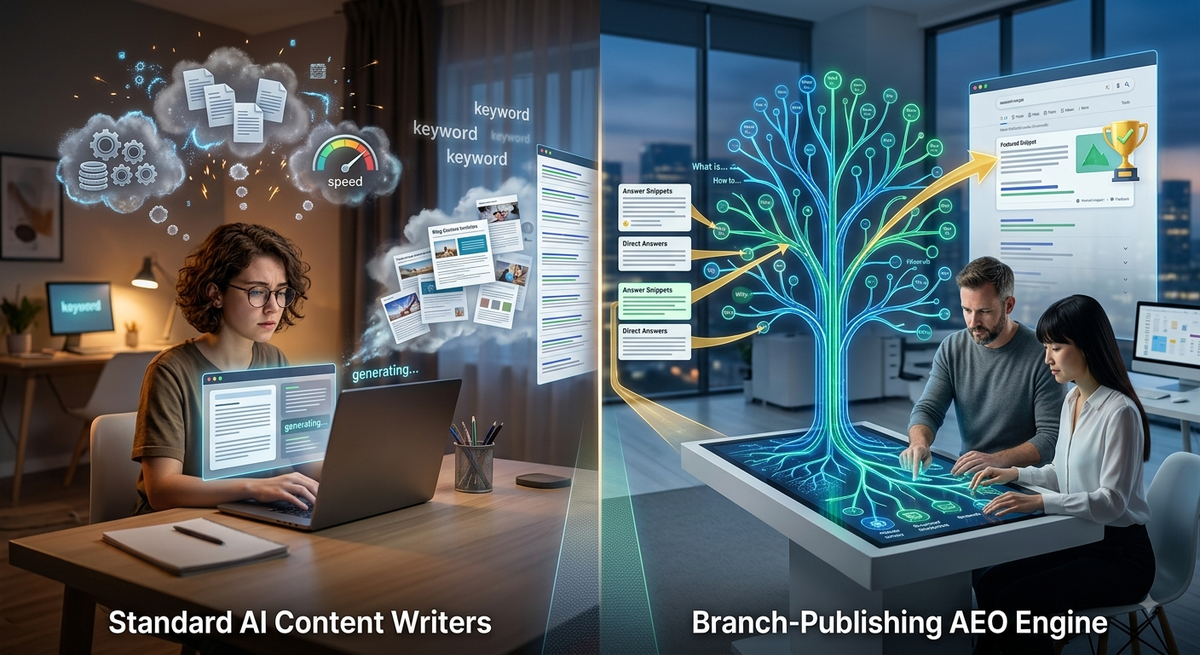
When someone searches "best ai content writer tools," they're usually trying to solve a speed problem — how do I produce more content, faster? That's a real problem, and there are dozens of capable tools to solve it. But for multi-location businesses, content speed turns out to be the wrong constraint to optimise. The deeper problem isn't how fast you write — it's whether what you publish actually earns a local citation from ChatGPT, Gemini, or Google Ask Maps when someone in your market types "best [service] near me."
Key Takeaways
- AI content writer tools — ChatGPT, Gemini, Jasper, Writesonic — produce drafts fast, but none of them crawl branch locations, build persistent brand memory, or publish directly to your domain.
- Ask Maps shows 3–8 businesses per query (Search Engine Land, April 2026), not a ranked list of dozens — if your branch isn't in that set, it effectively doesn't exist for that customer.
- 78% of local service brands are invisible to Ask Maps (5W AI Visibility Index, 2026), largely because they rely on centralised brand content rather than branch-specific proof.
- A branch-publishing AEO engine is purpose-built for multi-location operators (3+ branches) who need every branch cited in AI answers — it crawls, writes, publishes, and tracks across WordPress or Ghost on the business's own domain.
- First lift from branch-specific content typically appears in 4–8 weeks — not overnight, and not from a prompt-and-paste workflow.
- Paigent's customer data shows +30–56% more local visits within 90 days across its network (results vary by market).
---
What AI Content Writer Tools Actually Do Well
The best AI content writing tools are genuinely impressive at what they were built for. Here's a direct comparison before getting into where the category runs out of road.
| Dimension | General AI Content Writers | Practical takeaway |
|---|---|---|
| Draft speed | Seconds to a complete blog post | Right for solo creators, content teams, campaign bursts |
| Content variety | Blog posts, social copy, landing pages, emails | High versatility — works across formats and tones |
| Location specificity | Manual — you provide every local detail | You write the brief; the tool fills in prose |
| Brand memory | Session-based or via pasted context | Doesn't crawl your site or persist between sessions without plugins |
| Publishing | Copy-paste or limited integrations | CMS workflow remains a manual step |
| Schema / structured data | Not generated — prose only | AI search engines can't machine-read the output |
| Scale across branches | Linear — one prompt per location, every time | 50 locations means 50 separate prompts, reviews, and edits |
| Fit | Right if you need fast, flexible prose with a team to brief, edit, and publish | Wrong fit if you need AI-citation-ready content deployed across dozens of branches without a content team |
General AI writing tools — ChatGPT, Gemini, Copilot, Writesonic, Jasper — are genuinely useful when you have a writer or marketer who knows how to prompt them, edit the output, and manage the CMS. A Siege Media study of 1,000+ content marketers (2026) found that 97% plan to use AI to support content marketing in 2026, up from 64.7% in 2023. That trajectory reflects real utility. These tools make a skilled content team faster.
The operative word is team. Every step between "generate draft" and "published, citation-ready page" remains human work. That's manageable at one location. It becomes an operational ceiling at ten.
---
Where the Category Stops Short for Multi-Location Brands
Here's the failure mode nobody in the "best ai content writer tools" conversation discusses: content quality is not the bottleneck for multi-location local visibility. Citation-readiness is.
When a homeowner asks Google "best HVAC company near me," Ask Maps doesn't retrieve the most polished blog post. It retrieves the location it can confidently identify as a local authority for that query — a business whose name, address, service area, and FAQ answers are machine-readable, not buried in prose. A competent blog post without structured schema is invisible to that retrieval layer. It's like printing a great business card and locking it in a drawer.
There's also the fabrication problem. Prompted AI will write something for every location — but it will fill gaps. Ask it to write about "our Dallas branch's commercial HVAC expertise" without giving it real facts, and it may invent certifications, response times, service areas. For licensed trades — HVAC, electrical, plumbing — that's not a content risk, it's a compliance risk.
The third problem is scale. Writing genuinely local content for one branch takes research, drafting, schema tagging, and publishing. For fifty branches, that's not a content project. It's a logistics operation. Most multi-location operators don't have a content team at all; they have an owner, a manager, and a phone. For a closer look at where these tools genuinely move the needle, this overview of AI content writing tools for SME businesses breaks down the tradeoffs by business type.
---
How a Branch-Publishing AEO Engine Works — Step by Step
A purpose-built AEO content engine runs a full content-to-citation pipeline for every branch. The following steps use Paigent's published workflow as the concrete example.
- Crawl and brand memory build. The system crawls each branch location — real services, real service areas, real USPs, and any existing reviews. It builds a persistent brand memory per branch, grounded in actual facts, with gates that block fabricated stats or qualifications.
- Keyword and intent mapping. For each branch, the engine identifies the specific queries local customers actually search — "best pediatric dentist near me," "emergency electrician in [city]," "who installs EV chargers near [neighbourhood]." These map to branch-specific content slots, not cloned from a single template.
- Branch-specific content generation. Each branch gets its own blog posts, service pages, and FAQ schema — written to reflect that location's market context and local intent. An Austin clinic and a Dallas clinic become two genuinely different pieces of content, not two renamed copies.
- Schema injection. Every post ships with structured data — LocalBusiness, Article, and FAQPage JSON-LD — so each location's name, address, service area, and Q&A are machine-readable. AI answer engines parse the entity rather than guessing from prose.
- Publishing to your own domain. Content goes live on your WordPress or Ghost site — your domain, not a third-party directory. Every AI citation points to a page you own, building domain authority you keep.
- Tracking and iteration. Analytics show where AI answers are sending customers per branch, so the content strategy adjusts to what's actually driving local recommendations.
Published deployment specs: 8 branches in 2 weeks for electrician networks, 15 branches in 3 weeks for home services operators, and 10 branches in 2 weeks for landscaping companies.
---
The Brand AEO vs Local AEO Gap Nobody Talks About
Most multi-location brands invest in brand-level AEO — a strong homepage, optimised service pages, maybe a national blog strategy. That content ranks the brand in general AI searches. It does nothing for the branch.
When someone in Denver searches "best mortgage broker in Denver," Ask Maps doesn't examine the national brand page. It looks for a Denver-specific page proving Denver expertise: local lenders, local neighbourhoods, local closing timelines. Centralised content can't prove that. It can't prove it for Denver, Miami, Austin, and Phoenix simultaneously. Each branch needs its own proof, in its own market.
This is the Brand AEO ≠ Local AEO gap. It's the reason 78% of local service brands are invisible to Ask Maps despite having functional websites. The brand is visible. The branch is not. Ask Maps picks one winner per local search — if your branch doesn't have location-specific proof, it picks a competitor that does.
For a closer look at the underlying mechanics, this post on what actually wins local AI search covers why branch-specific content outperforms centralised brand pages in AI answer retrieval.
---
Who Should Use an AEO Engine — and Who Shouldn't
This is worth being direct about, because the answer depends heavily on your operating context.
A branch-publishing AEO engine is well suited to multi-location service businesses where walk-in or call-in traffic matters and customers search locally — mortgage lenders with 150 branches, restaurant groups with 40 locations, HVAC and plumbing companies with a dozen branches, or dental clinic networks competing for "best pediatric dentist near me" queries across multiple neighbourhoods. If each location has its own Google Business Profile and local demand, that's the operating context this category is built for.
If you mainly need a capable writing assistant for a single-location business, or you're running an online-only brand with no physical presence, a general AI content writer is a better fit — and considerably less infrastructure than the situation requires. Similarly, if you want to hand-control every word before it publishes, an automated branch-publishing workflow isn't designed for that level of manual intervention.
One honest constraint worth naming: first results typically appear in 4–8 weeks. Ask Maps authority builds as content publishes and signals accumulate. No content system delivers a recommendation spike in 30 days; any tool claiming otherwise is overstating what content authority actually requires.
---
Where Paigent Fits
Paigent occupies a specific position in this landscape: it's a branch-publishing AEO engine, not a general AI writing tool. The distinction matters because these are structurally different categories with different use cases, not competing versions of the same thing.
General AI writing tools belong in the workflow of content teams and marketers with the bandwidth to brief, edit, and publish manually. They're fast and flexible. For single-location businesses that want to blog regularly, they're often the right call.
Paigent's purpose is narrower: deploying citation-ready, branch-specific content across multiple locations without requiring a dedicated content team to manage the per-location briefing-and-publishing cycle. That's the specific bottleneck it's built to remove — and it's not a bottleneck that exists at one location.
---
If you operate three or more locations and want to see what branch-specific AEO content looks like in practice, getpaigent.com has a 14-day free trial with no credit card required.
---
Frequently Asked Questions
What's the difference between an AI content writing tool and an AEO content engine?
AI content writing tools generate prose quickly from a prompt — designed for speed and flexibility across formats. An AEO content engine is purpose-built to make content machine-readable and citation-eligible for AI answer systems like Google Ask Maps, ChatGPT, and Gemini. The structural difference is schema injection, persistent brand grounding, and direct domain publishing — none of which general writing tools handle automatically.
Can I just use ChatGPT or Gemini to write local content for each branch?
You can, but the workflow doesn't scale and the output typically isn't citation-ready. Each branch requires a separate prompt loaded with real local facts; without them, AI writers fill gaps with invented details — a compliance risk for licensed trades. The output also lacks structured data: the JSON-LD schema that lets Ask Maps parse your location, services, and Q&A as machine-readable entities. Prose alone rarely earns an Ask Maps recommendation.
What does "Ask Maps shows 3–8 businesses per query" mean for local visibility?
According to Search Engine Land (April 2026), Ask Maps returns 3 to 8 business recommendations per query — not a ranked list of dozens. Every position outside that set is invisible to the customer asking the question. For multi-location brands, each branch must independently qualify for that set in its own market. A national brand page alone doesn't qualify a branch for a city-specific search.
How is branch-specific content different from just adding a city name to a template?
Genuine branch-specific content reflects real local facts — the services offered at that location, the neighbourhood it serves, local market context, and the specific queries customers in that market actually search. Cloned templates with swapped city names are detectable by answer engines and by readers. Each location's content needs to be grounded in its own crawled facts, making each branch a distinct local answer rather than a renamed copy.
How long before branch-specific content starts affecting local AI recommendations?
First lift typically appears in 4–8 weeks. Ask Maps authority accumulates as content publishes and signals build over time. Paigent's customer data shows +30–56% more local visits within 90 days across its network (results vary by market) — meaningful change, but not an overnight spike. Any system promising results in 30 days is overstating what content authority actually requires.
Is a purpose-built AEO engine the right fit for a single-location business?
For a single-location business, a general AI content writing tool paired with careful Google Business Profile management is usually the better fit. AEO content engines are designed to deploy branch-specific content at scale — across 10, 50, or 150 locations — where manual content creation becomes operationally impossible. The leverage comes from eliminating the per-location briefing-and-publishing cycle, which isn't a bottleneck at one location.
Does publishing content to your own domain matter for AI citations?
Yes. Content published to a third-party directory earns a citation for the directory's domain, not yours. Publishing branch-specific content to your own WordPress or Ghost domain means AI answer engines — ChatGPT, Gemini, Perplexity, Ask Maps — cite your URL directly, building authority on a digital asset you own and control rather than a platform you don't.