Best AI for Writing Blogs: Why Branch-Specific Content Wins Local AI Search
Comparing the best AI for writing blogs vs branch-specific content tools built for Ask Maps. Learn why local AI search needs location-level proof, not generic output.

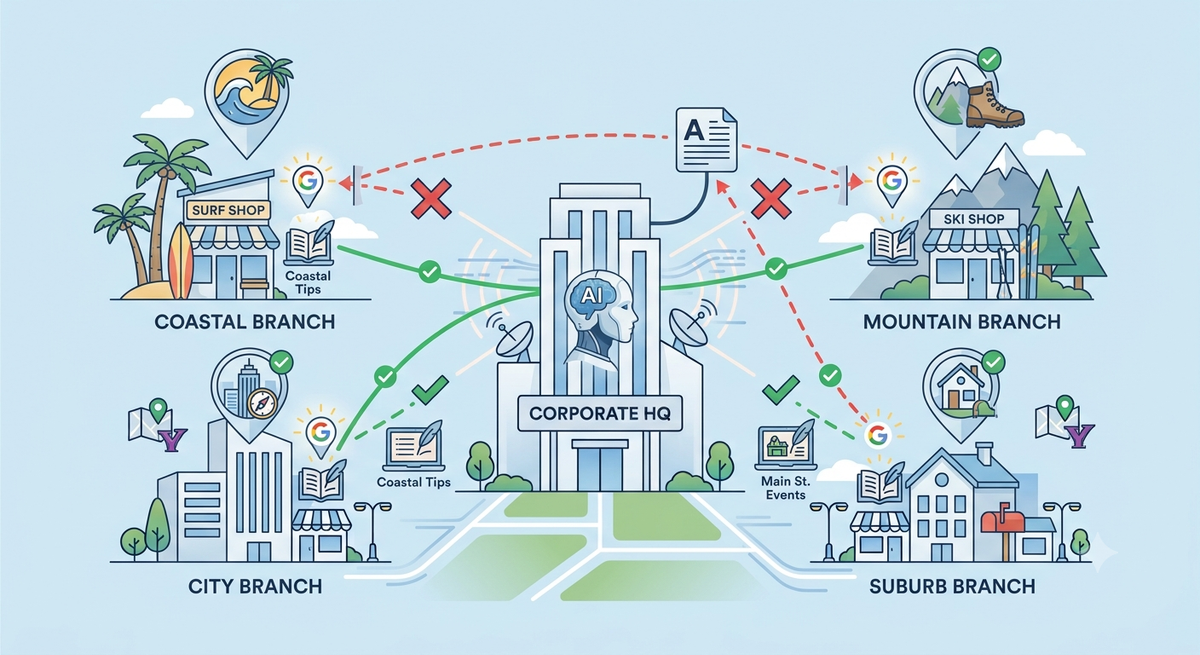
The best AI for writing blogs depends entirely on what "winning" means for your business. For national content or single-location brands, general-purpose AI writers do the job well. For multi-location service brands competing in Google Ask Maps, the question isn't which AI writes the most fluent prose — it's which one generates content that signals branch-level authority to Gemini.
What "Best AI Writer for Blog" Actually Means Depends on the Search Signal
The answer shifts based on where your customers discover you.
A 2026 Siege Media and Wynter survey found that 97% of content marketers plan to use AI for content, with ChatGPT leading adoption at 80% among respondents. AI-assisted blog writing is now the default, not the exception.
But there's a harder finding underneath that trend. A Semrush analysis of 20,000 keywords and 42,000 blog posts found that purely AI-generated content ranked in the top search position only 9% of the time, compared to 80% for human-written content. The implication isn't that AI writing fails — it's that undifferentiated AI output, produced without location-specific context or local proof signals, earns very little trust from search algorithms.
That distinction matters even more in Ask Maps, where Google's Gemini layer reads branch-level content to decide which businesses to recommend. Generic blog content — the kind any AI writer produces without local grounding — doesn't prove that a specific branch is the right answer for "best HVAC company in Scottsdale." It just proves the brand exists.
Here's where the tools diverge in practice:
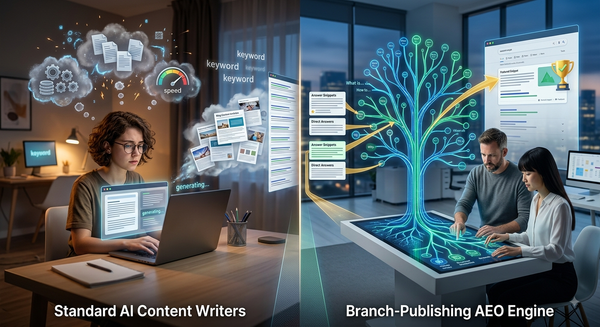
| Dimension | Generic AI Blog Writers | Branch-Specific AI (e.g. Paigent) | Practical Takeaway |
|---|---|---|---|
| Content scope | Brand-level topics, no location context | Per-branch content: profiles, service pages, FAQs | If you have 10+ locations, brand-level posts leave individual branches invisible |
| Ask Maps signals | Not optimised for Gemini's recommendation layer | Generates Gemini-readable content with LocalBusiness + FAQPage + Review JSON-LD schema per branch | Ask Maps reads structured schema signals; generic posts don't carry them |
| Scale | Manual prompt per post, per location | 6–25 branches deployed per 2–3 weeks on autopilot | At 50 locations, manual AI writing per branch is not operationally viable |
| Local proof integration | No review or GBP sync | Daily GBP sync + weekly content refresh from live review data | Fresh, location-tied signals are what Ask Maps scores for recency and relevance |
| Brand voice consistency | Varies by prompt; requires human QA per post | Consistent voice across all branches, all topics, automated | Inconsistent tone across 50 branches creates audit risk and erodes trust |
| Best fit | Single-location brands, national content, editorial blogs | Multi-location service brands (3+ branches) needing local AI search visibility | Tool selection should start with this fit question, not a feature list |
| Practical takeaway | Strong general-purpose writing tool; limited local AI ranking impact | Purpose-built for Ask Maps visibility at branch scale | The wrong tool for local AI search isn't a bad tool — it's a mismatched one |
The decision logic is straightforward: if your branches need to appear when customers ask Gemini for a recommendation in a specific neighbourhood, generic AI blog tools won't solve that problem. They were built for a different job.
The Core Problem: Brand AEO ≠ Local AEO
Brand AEO and Local AEO are not the same thing. Conflating them is the most common mistake multi-location brands make.
Brand AEO builds authority at the company level. It answers questions like "What does this brand do?" and "Is this a credible company?" A well-written corporate blog, a strong knowledge panel, and consistent NAP data across directories are all Brand AEO signals. Generic AI blog writers are genuinely useful here — they can produce topical, on-brand content at volume that reinforces brand authority in broad search.
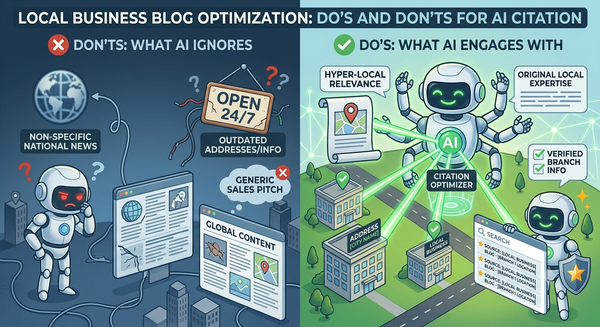
Local AEO does something different. It answers the question a customer is actually typing: "Who should I call in my neighbourhood, right now, for this specific service?" Gemini doesn't answer that with brand-level content. It reads branch-specific profiles, FAQ schema tied to local service areas, review signals from individual locations, and service pages that demonstrate relevance to the specific query.
That's the gap. A mortgage lender with 150 branches might have excellent brand-level blog content explaining how home loans work. None of it tells Ask Maps that the Denver branch is the right answer for "best mortgage broker in Denver." The Denver branch needs its own proof: local service area content, Denver-specific FAQs, reviews from Denver borrowers, and schema that ties all of it to that location's Google Business Profile.
This gap between corporate website authority and branch-level local ranking is structural — it doesn't close by publishing more brand-level content. It closes only when each branch builds its own content authority independently.
An Ahrefs survey of 879 content marketers found that 87% now use AI to create content, with blog posts as the most common output type. Most of that content is brand-level. The local layer is still largely unaddressed — which is exactly why multi-location service brands so often find their individual branches invisible in Ask Maps even when their corporate domain ranks well.
How Google Ask Maps Actually Decides Who to Recommend
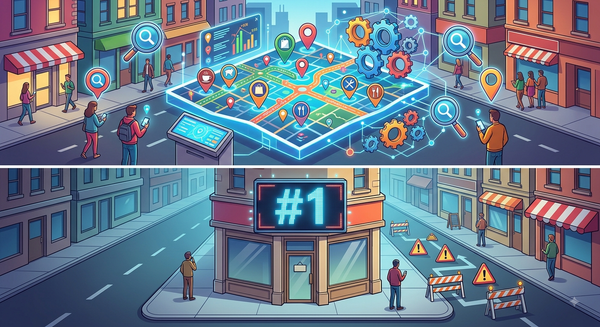
Ask Maps shows 3–8 businesses per query, according to Search Engine Land (April 2026). Not dozens. Not a ranked list where position 14 still captures some traffic. Three to eight — that's the entire competitive set.
Gemini selects those recommendations by reading a specific set of signals:
- Branch-level structured data — LocalBusiness, FAQPage, and Review JSON-LD schema tied to the individual location's GBP, not the corporate domain
- Content freshness — active publishing signals (weekly refreshes, new FAQ content) that indicate the location is currently serving customers
- Review proof — volume and recency of reviews tied to the specific branch, not the brand aggregate
- Service-area specificity — content that names the neighbourhoods, cities, and local contexts the branch actually serves
- Query-intent matching — FAQ schema that mirrors the conversational language customers use ("who fixes AC at night in Phoenix" reads differently than "HVAC services")
Generic AI blog writers don't generate any of these signals by default. They produce prose — good prose, in many cases — but prose without structured schema, without GBP sync, and without the location-level proof Gemini is actually reading.
How Branch-Specific Blog Generation Actually Works: A Process View
Branch-specific content generation for Ask Maps isn't just "writing a local version of a blog post." The workflow is distinct from generic AI writing from step one.
- Establish brand voice and business model at the platform level. The system ingests how the brand speaks, what it sells, and what differentiates it — so every branch output stays on-brand without human QA per post.
- Add branches and pull location-specific data. Each branch profile draws from its Google Business Profile: actual service areas, active categories, review corpus, and operational details. This is raw material generic AI writers never access.
- AI identifies what makes each location unique. Rather than spinning the same template with a city name swapped in, the system surfaces branch-specific differentiators — a particular service concentration, a neighbourhood coverage area, a cluster of reviews around a specific job type.
- Generate branch-specific content: profiles, service pages, FAQ schema, and review proof. Each piece is written to serve a specific local search intent. A dental clinic in Scottsdale gets FAQ schema about pediatric dentistry in Scottsdale; a restaurant in Beverly Hills gets content proving it's the answer for "best sushi in Beverly Hills," not just that the chain exists.
- Deploy structured schema per branch. LocalBusiness, FAQPage, and Review JSON-LD publish alongside the content — not as an afterthought, but as a core output. This is the layer Gemini reads to confirm branch-level relevance.
- Maintain freshness with daily GBP sync and weekly content refresh. Ask Maps weights recency. Content that publishes once and sits static loses ground to branches actively adding signals. The sync cycle keeps each branch's proof current without manual intervention.
Paigent's local AEO solution runs this workflow across 10 to 150+ branches in 1–3 weeks. The manual equivalent — briefing, writing, optimising, publishing, and schema-tagging branch-specific content for 25 locations — isn't a marketing task. It's a full-time team.
The Content Quality Trap Generic AI Writers Set
Good AI blog content can be fluent, accurate, and on-brand. It can cover a topic thoroughly and pass any readability test you run. It still won't rank a branch in Ask Maps — not because the writing is poor, but because the output type is wrong for the problem.
Local AI search doesn't reward good writing. It rewards branch-level proof. A well-written 1,200-word post about "how to choose an HVAC company" is Brand AEO content. It builds topical authority for the brand and may rank organically for informational queries. But when a homeowner asks Gemini at 2 AM "who can fix my AC right now in Mesa," that post doesn't surface a specific branch. It proves the brand knows about HVAC.
The distinction matters operationally. If you're investing in AI blog writing to win organic rankings for informational content, general-purpose tools are efficient and well-suited for that job. If the goal is local AI search — putting specific branches in front of customers who are ready to call — content type, schema, and GBP integration determine the outcome, not prose quality.
For multi-location brands competing in categories like HVAC and plumbing, dental clinics, or salons, the local search intent is the entire commercial case. Customers don't discover those businesses through editorial blogs. They ask Maps who to call.
Where Paigent Fits
Paigent is a purpose-built Ask Maps visibility platform, not a general-purpose AI writing tool. That distinction matters for fit.
It's built for multi-location service brands — three or more branches — where each location needs to rank independently for local "near me" queries. The platform automates the workflow from branch data ingestion through content generation, schema deployment, GBP sync, and publishing.
It is not the right tool for a single-location business, an online-only operation with no physical presence, or a brand that needs results inside 30 days. First Ask Maps visibility improvements typically appear in 4–8 weeks as content publishes and authority signals accumulate. The workflow is automated, which means less manual control per post — operators approve content, but generation and publishing run on autopilot. Teams that need to rewrite every generated piece before publishing will find that friction high. For brands building editorial content or topical thought leadership rather than local proof, a general-purpose AI writer is a better fit.
The comparison with Jasper is a useful reference if you're currently evaluating general-purpose AI writing tools alongside Ask Maps-specific platforms — the tradeoffs are concrete.
Who Is Best Suited for Branch-Specific Content Tools — and Who Might Consider an Alternative
Branch-specific content platforms make most sense for brands that check these criteria: three or more physical locations, active Google Business Profiles on each, and customers who discover through local "near me" queries rather than brand name search. Businesses where walk-in or call-in traffic is the primary revenue driver — home services, general contractors, HVAC, dental groups, restaurant chains — fit this profile because that traffic increasingly arrives through Ask Maps recommendations rather than organic clicks.
Consider a different approach if:
- You have one location. A branch-specific model doesn't map to a single-location setup. A general-purpose AI writer paired with manual GBP management is more appropriate.
- You need results in 30 days. The 4–8 week timeline for first visibility improvements is consistent — Ask Maps authority isn't instant. If you're in a traffic crisis, this timeline won't solve it in time.
- You want full manual control over every post. Automated generation is the core of how these platforms operate. Operators who want to rewrite every piece before publishing will work against the tool's design.
- You don't have Google Business Profiles. The content and schema layer publishes to and syncs with GBPs. Without them, there's no local anchor to optimise against.
- You're building editorial content, not local proof. If your content goal is topical authority or lead generation through informational blogs, a general-purpose AI writer is a better tool for that job.
---
If your branches are invisible in Ask Maps right now, the content type you're producing — not the quality of it — is likely the cause. Explore what branch-specific proof generation looks like for your industry at getpaigent.com.
Frequently Asked Questions
What makes a blog post rank in Google Ask Maps rather than organic search?
Ask Maps rankings depend on branch-level structured data — LocalBusiness, FAQPage, and Review JSON-LD schema — tied to a specific Google Business Profile, not on prose quality or word count. Content that names local service areas, mirrors conversational query language, and publishes regularly with GBP sync carries the signals Gemini reads for recommendations. A generic blog post without that schema layer doesn't compete for Ask Maps placement, regardless of how well it's written.
What's the difference between Brand AEO and Local AEO for multi-location brands?
Brand AEO builds authority at the company level — topical coverage, knowledge panels, consistent NAP data. It answers "is this a credible brand?" Local AEO operates per branch and answers "is this specific location the right answer for a customer in this neighbourhood right now?" Multi-location brands need both, but they require different content strategies. Shared corporate blog content contributes to Brand AEO but doesn't prove individual branch relevance to Ask Maps.
How many businesses does Ask Maps show per local search query?
According to Search Engine Land (April 2026), Ask Maps shows 3–8 businesses per query. That's the full competitive set — there's no page 2, no position 14 to capture some traffic. If a branch isn't in that 3–8, it is not visible for that query. This is why branch-specific, optimised content matters more in Ask Maps than in traditional organic search, where traffic distributes across many positions.
Can a generic AI writing tool generate branch-specific content at scale?
General-purpose AI writers produce content based on prompts, not on live GBP data or location-specific review signals. They can write a local-sounding post if prompted carefully, but they don't automatically sync with each branch's Google Business Profile, deploy structured schema per location, or refresh content weekly to signal freshness. At 10 or more branches, manually prompting and schema-tagging individual posts per location becomes operationally unworkable for most teams.
How long does it take to see Ask Maps visibility improvements after publishing branch-specific content?
First Ask Maps visibility improvements typically appear in 4–8 weeks after branch-specific content goes live. Ask Maps authority builds as content publishes, schema signals accumulate, and GBP sync reinforces freshness. This isn't instant — it's a signal-building process, not a switch. Brands that need traffic inside 30 days should weigh this timeline carefully before committing to a branch-specific content strategy.
Is purely AI-generated blog content effective for organic search rankings?
According to a Semrush analysis of 20,000 keywords and 42,000 blog posts, purely AI-generated content appeared in the top organic search position only 9% of the time, compared to 80% for human-written content. That gap closes significantly when AI output is grounded in real, specific data — location signals, review content, structured schema — rather than generic topic coverage. The differentiation of inputs determines the differentiation of outputs.
What type of multi-location brand benefits most from branch-specific AI blog content?
Brands where customer acquisition depends on local "near me" queries benefit most — HVAC companies, dental groups, restaurant chains, real estate teams, salons, and home service operators. Any business where the customer's first action is asking a local question in Maps rather than searching a brand name. Brands with strong organic rankings but declining walk-in traffic are often experiencing the Ask Maps shift: customers stopped clicking results and started following AI recommendations.