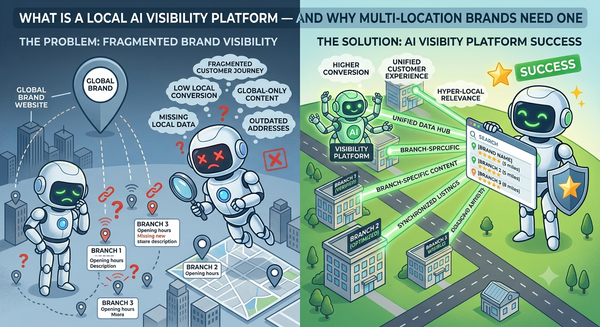
Do's and Don'ts of Writing a Local Business Blog Using Chatgpt, Gemini and others That AI Engines Actually Cite
Do's and don'ts for writing local business blogs that earn AI citations in ChatGPT, Gemini, and Ask Maps — with a head-to-head comparison of general AI tools vs. Paigent.

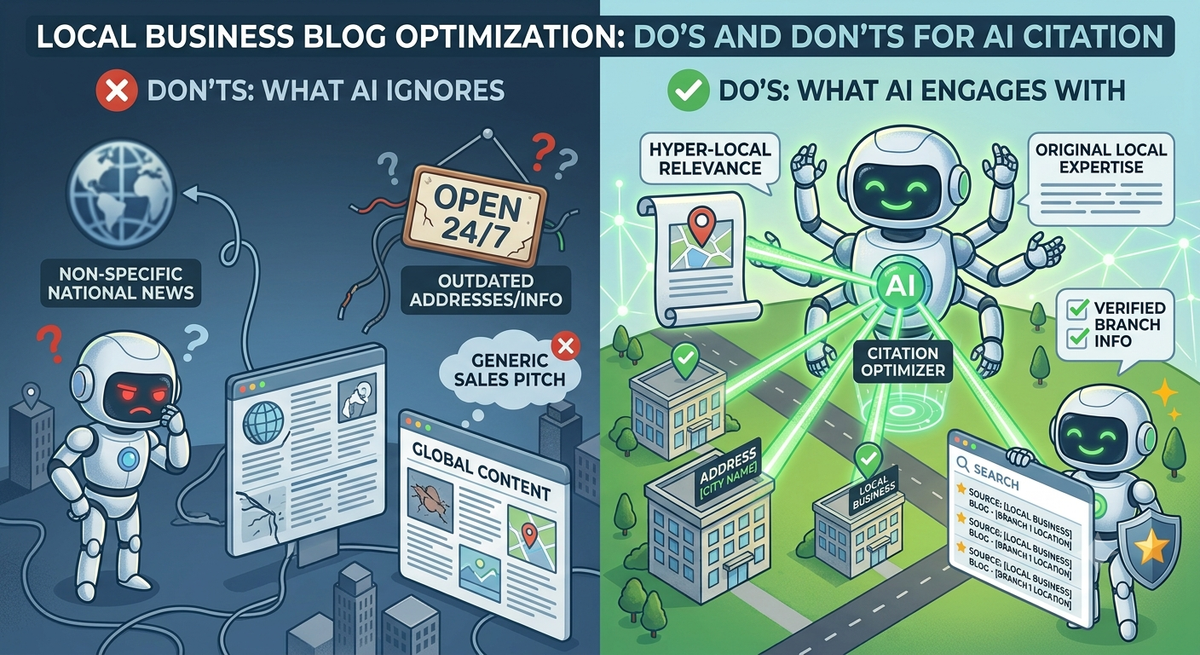
Writing a blog post for your local business isn't hard. Writing one that earns a citation in ChatGPT, Gemini, or Perplexity when a customer asks "best HVAC company near me" — that's a different job entirely. Most local business blogs fail not because they're poorly written, but because they're built for the wrong outcome: they satisfy a human reader while remaining structurally invisible to AI answer engines. This post breaks down exactly what separates a blog that ranks locally from one that sits unread, with a head-to-head look at how general-purpose AI tools handle this job versus a purpose-built local AEO platform.
Key Takeaways
- Ask Maps shows only 3–8 businesses per query (Search Engine Land, April 2026) — a single poorly structured blog post can be the difference between appearing in that list and being invisible.
- 78% of local service brands are currently invisible to Ask Maps (5W AI Visibility Index, 2026) — the gap isn't competition, it's missing branch-specific content.
- ChatGPT, Gemini, Perplexity, Grok, and Copilot can all draft a blog, but none maintains persistent brand memory, enforces anti-fabrication grounding against your real facts, or structures content for AI-answer citation automatically.
- Paigent's anti-fabrication gates prevent invented stats, quotes, and certifications from reaching publication — a failure mode all five general-purpose tools share.
- Brand AEO ≠ Local AEO: centralized brand content won't rank locally; each branch needs its own proof, and writing that manually for 50+ locations is operationally impossible.
- Paigent deploys branch-specific, Gemini-readable content for 10–150+ locations in 1–3 weeks — confirmed across Home Services (15 branches, 3 weeks), Cleaning Services (25 branches, 2 weeks), and Electricians (8 branches, 2 weeks).
The Do's: What a Local AI-Optimized Blog Actually Needs
A local business blog earns AI citations when it answers a specific question, from a specific location, with verifiable proof. That's the structure answer engines extract.
Do lead every section with a direct, self-contained answer. ChatGPT, Gemini, and Perplexity don't read your blog like a human. They scan for paragraphs that resolve a question cleanly — without needing surrounding context. If your H2 section buries the answer after three sentences of scene-setting, it won't get cited. Write the answer in the first sentence, every time.
Do anchor every claim to real, verifiable facts. This is where most local blogs — and most general-purpose AI tools — break down. ChatGPT will confidently produce a stat it can't source. Gemini will cite research that doesn't apply to your specific business. The blog that earns local AI visibility says "our Denver branch has served homeowners in LoDo and Highlands since 2018" — not "our team brings years of experience to every job." Gemini-readable content has to be grounded in specifics that signal branch-level authority, not brand-level generalities.
Do include location-specific proof in every post. A Beverly Hills sushi restaurant writing "we serve the best sushi in LA" is invisible in Ask Maps. A post that names the neighbourhood, the specific dish, the occasion — "best omakase in Beverly Hills for a business dinner" — gives Ask Maps the exact signal it needs to recommend that branch. Without location-specific proof, Ask Maps picks a competitor. Every time.
Do use structured formatting: H2 headings, numbered steps, FAQ schema. AI answer engines extract structured content. A paragraph with no heading and no clear question-answer structure is noise to an extraction engine, even if it reads well. Use H2 headings that mirror real search queries. Use FAQ sections at the end of every post. These aren't stylistic choices — they're extraction targets.
Do maintain author E-E-A-T signals. Real author credentials, real business proof, real customer reviews. These are the signals that tell Gemini and AI Overviews that this content comes from a practitioner, not a content mill. General-purpose AI tools don't capture or surface these signals automatically. They need to be built into every post, not added as an afterthought.
The Don'ts: What Kills Local AI Visibility Fast
The mistakes below aren't obvious — they're committed by businesses actively trying to rank. That's what makes them expensive.
Don't write for a generic audience. A dental clinic blog titled "5 Tips for a Healthy Smile" competes with WebMD. It won't win. A post titled "What to Expect at Your First Pediatric Dental Appointment in Austin" is answering a local question for a local audience. Ask Maps rewards specificity. Generic content is invisible to it.
Don't let AI tools invent your proof points. This is the single most damaging error multi-location brands make when using ChatGPT or Grok for local content. Both tools, absent grounding in your real business data, will fabricate statistics, quote certifications you don't hold, and describe outcomes you've never produced. A fabricated local claim doesn't just fail to rank — it actively damages trust when a customer or Google catches it. Perplexity cites from public sources; it won't cite from your real business facts unless those facts are already published and structured.
Don't publish centralized brand content and expect local results. This is the Brand AEO ≠ Local AEO gap. One corporate blog post about your HVAC services doesn't prove to Ask Maps that your branch on the north side of Phoenix specializes in emergency AC repair for that neighbourhood. Centralized content won't rank locally. Each branch needs its own proof — its own page, its own service content, its own review signals.
Don't write every topic in isolation. A common mistake: publishing three posts on the same topic, covering no part of the buyer journey beyond awareness. A functional local content strategy maps across the full funnel — awareness posts, comparison posts, decision posts. Without that structure, you're accumulating content without accumulating visibility. General-purpose AI tools handle one topic at a time with no awareness of what you've already published.
Don't ignore your Google Business Profile as a content signal. Your GBP isn't a static listing. It's a live input to Ask Maps' ranking logic. Freshness, completeness, and consistency between your GBP and your published content are active signals. A blog post that contradicts your GBP data — different service areas, inconsistent hours, mismatched categories — sends a coherence failure signal to Gemini. Google sees coherence. Coherence equals visibility.
ChatGPT, Gemini, Perplexity, Grok, and Copilot: What Each Actually Does for Local Blogs
Each general-purpose tool has a genuine strength. None of them was designed for this specific job. Here's the honest breakdown.
| Tool | Real Strength | What It Leaves You Doing | Local AEO Gap |
|---|---|---|---|
| ChatGPT | Fast drafts, versatile, huge ecosystem | Re-paste brand facts every session; no memory of past posts | No local lane, no anti-fabrication grounding, no dedup |
| Gemini | Google integration, large context, search grounding | Grounding helps Gemini's answers — not your citation-worthiness | No per-business profile, no GBP strategy, no dedup |
| Perplexity | Research-first, live web, transparent citations | Writes from public sources — not your real business facts | Consumes citations; doesn't produce brand-grounded citable content |
| Grok | Real-time X/Twitter, conversational style | No brand memory, no AEO structure, no publishing pipeline | No local lane, no funnel, no dedup |
| Copilot | Excellent inside Microsoft 365, document drafting | Grounded in your files — not a public web content model | No CMS publishing, no dedup, no local AEO strategy |
Perplexity is worth calling out separately because the dynamic is the inverse of the others. Perplexity is an answer engine — it consumes citations. Paigent produces the brand-grounded, extractable content that engines like Perplexity cite. That distinction matters. Using Perplexity to write your local blog is like asking a librarian to build your library. They understand the system; they're not the input to it.
ChatGPT and Grok will write a competent post, fast. The problem is everything after the draft: no memory of your brand between sessions, no awareness of your publish history, no structure for AI-answer citation, and a well-documented tendency to invent plausible-sounding facts when real grounding is absent. For a one-off post, that's manageable with careful human oversight. For 50 branches publishing weekly, it's operationally impossible.
Copilot grounds in your Microsoft 365 files — useful for internal documents, not for public brand content optimized for open-web AI search. Gemini's Search grounding is genuinely strong, but it helps Gemini answer questions about the world — not answer questions about whether your branch is the right dental clinic in suburban Atlanta.
For a deeper look at how general-purpose AI writers compare on this dimension, Best AI for Writing Blogs: Why Branch-Specific Content Wins Local AI Search covers the fluency vs. citation-worthiness distinction in full.
How Paigent Generates a Citation-Ready Local Blog
Paigent's workflow replaces manual prompting with a system. Here's exactly how it runs, from brand setup to published post.
- Set up brand voice and business model. Paigent crawls your site and captures your real facts — services, differentiators, ideal customer, existing content — into a persistent brand memory that every post draws from. You never re-paste your context into a chat window.
- Add branches. Input your locations: 10, 50, 150+. Paigent identifies what makes each branch distinct — its service area, its neighbourhood, its specific offerings, its review signals.
- AI identifies branch-specific content topics. Rather than one topic at a time, Paigent generates a full keyword-clustered content calendar per branch — covering the full awareness-to-decision funnel, with no overlap against what you've already published (semantic dedup runs across your entire corpus).
- Content is generated and scored before it ships. Every post is structured for AI-answer citation: answer-first H2s, FAQ schema, E-E-A-T signals, local anchors. An AEO quality gate scores the post and revises it to a target before publication. A first draft is never the final draft.
- Anti-fabrication gates enforce grounding. Every claim is traced back to your real business facts. Paigent fails closed on sparse data — if a fact isn't in your brand profile or service pages, it doesn't appear in the post. This is the opposite of how ChatGPT and Grok handle missing information.
- Publish manually or on autopilot. Posts go live via CMS or scheduled publishing. Your Google Business Profile syncs daily; content refreshes weekly. Paigent for Dental Clinics and Paigent for HVAC & Plumbing show this full workflow applied to specific verticals.
First Ask Maps lift typically appears in 4–8 weeks as signals accumulate. Not 30 days. Not overnight. That's the honest timeline.
Why Choose Paigent
Paigent automates Ask Maps visibility for every branch — each location ranks for its own local AI search without manual content work. That's not a feature description. It's the operational reality for brands managing 10, 50, or 150+ locations: writing branch-specific content manually doesn't scale, and centralized brand content won't rank locally.
The platform generates branch-specific, Gemini-readable content at scale — branch profiles, service pages, FAQ schema, and review proof — tailored to each location. It gets branches into Google Ask Maps' top 3–8 recommendations, the only results that matter in local AI search. It's built for multi-location operators: 10, 50, 150+ branches live in 1–3 weeks.
No marketing team is required. Paigent automates the entire Ask Maps strategy, from data identification to content generation to publishing. It solves the Brand AEO ≠ Local AEO gap directly — centralized brand content won't rank locally; each branch needs its own proof, and Paigent generates that proof at scale. Content depth and breadth across every location, no manual lift, always fresh, always optimized for local intent.
The 14-day free trial requires no credit card. If you download generated content and decide it's not right, refund eligibility ends at that point — because the content is immediately usable for commercial purposes. For everyone else, the trial is the proof.
Who Paigent Is Best For — and Who Might Consider an Alternative
Paigent is best suited for multi-location service brands with 3 or more branches that need each location to rank in Google Ask Maps for local "near me" queries — without a dedicated marketing team. If your branches have Google Business Profiles and you're losing walk-in traffic to competitors who appear in Ask Maps' top 3–8, Paigent was built for that exact problem. The Paigent for Salons and Paigent for Home Services pages show what that looks like in practice.
If you operate a single location, Paigent is not the right tool — the platform's branch-specific content architecture is designed for scale, and a single-location business doesn't produce the volume of location differentiation the system is built around.
If you need results in 30 days, be realistic: first Ask Maps improvements appear in 4–8 weeks as content publishes and signals accumulate. Ask Maps authority builds over time. That's the nature of the signal — not a limitation of the platform.
If you want to manually control every word of every post, Paigent automates the generation and publishing workflow. You approve content, but you don't write it. Operators who need to micromanage every detail will find the automation frustrating rather than freeing.
And if you're looking for a pure content creation tool — something to help you write better blog posts one at a time — Paigent is the wrong category. It's an Ask Maps visibility platform. The content is the mechanism, not the product.
---
Writing a local business blog that earns AI citations is a systems problem, not a writing problem. The do's and don'ts above apply whether you're writing manually, using ChatGPT, or running Paigent — but only one of them automates the entire system at branch scale. If you're running 3 or more locations and Ask Maps is deciding right now who ranks in your market, visit getpaigent.com and start the 14-day free trial to see what branch-specific proof actually looks like for your locations.
Frequently Asked Questions
What makes a blog post rank in Google Ask Maps for local searches?
Ask Maps favors content that directly answers a local question with branch-specific proof: named neighborhood, specific service, and real business signals (reviews, GBP consistency, FAQ schema). A generic brand-level post won't rank for a branch-level query. Location-specific proof — tied to a verified Google Business Profile — is the structural requirement, not optional depth.
Why do general-purpose AI tools like ChatGPT fall short for local SEO blogs?
ChatGPT has no persistent memory of your business between sessions, no awareness of what you've already published, and a documented tendency to invent plausible-sounding facts when real grounding is absent. For a single post, careful human oversight manages this. For 50+ branches publishing weekly, there's no manual workflow that catches every fabrication or prevents duplicate angles across the corpus.
What is the difference between Brand AEO and Local AEO for blog writing?
Brand AEO builds centralized authority — your main site proves your business exists and is credible. Local AEO proves that a specific branch serves a specific area with specific expertise. Ask Maps evaluates branch-level proof, not brand-level content. A mortgage lender's corporate blog won't rank for "best mortgage broker in Denver" — only a Denver-branch-specific page with Denver-specific proof does.
How does Paigent prevent fabricated claims in AI-generated local blog content?
Paigent uses anti-fabrication grounding gates that trace every claim back to your real business data — crawled from your site and GBP. If a fact isn't in your brand profile or service pages, it doesn't appear in the published post. The system fails closed on sparse data, unlike ChatGPT or Grok, which generate confident-sounding content regardless of whether the underlying facts are real.
How quickly can a multi-location brand get branch-specific content live with Paigent?
Deployment timelines from Paigent's own service pages: 25 branches live in 2 weeks (Cleaning Services), 15 branches in 3 weeks (Home Services), 8 branches in 2 weeks (Electricians). First Ask Maps visibility improvements typically appear in 4–8 weeks after content publishes, as signals accumulate. This is not a 30-day result — Ask Maps authority builds incrementally, not overnight.
What does a citation-ready local blog post structure look like?
Each H2 section opens with a direct, self-contained answer — one or two sentences that resolve the implied question without needing surrounding context. Sections include location anchors, named services, and verified business facts. FAQ schema appears at the close of every post. This structure allows AI answer engines like Gemini and Perplexity to extract individual sections as standalone snippets, not just surface the page.
Is Paigent a good fit for a single-location local business trying to improve its local SEO blog?
No — Paigent is built specifically for multi-location brands with 3 or more branches. Its branch-specific content architecture, automated dedup, and GBP sync are designed for scale, not a single location. A single-location business writing local blogs would be better served by a general-purpose AI tool with careful manual grounding, or a local SEO content specialist who can build branch-level signals for one location directly.