Ask Maps Optimization: What It Is, How It Works, and Why Rankings Alone Won't Save You
Ask Maps Optimization explained: how Google's conversational AI picks 3–8 local businesses, what content signals matter, and why rankings alone won't get you recommended.

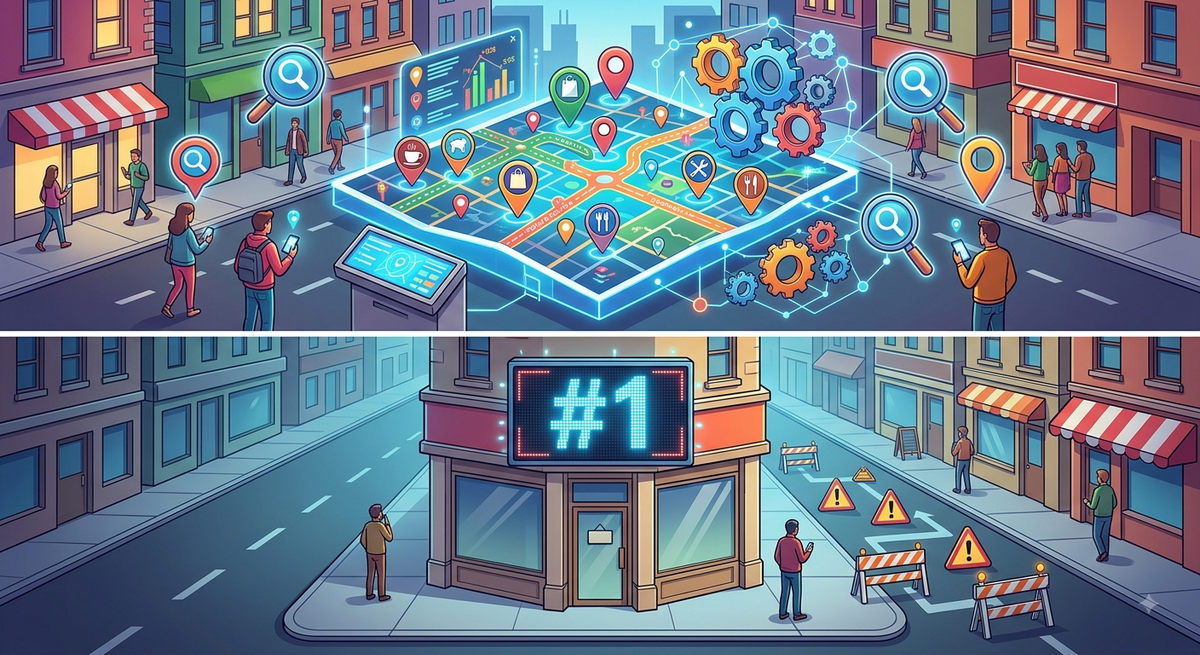
Google Maps recently added a conversational AI layer — Ask Maps — that completely changed how local businesses get discovered. Instead of seeing ten ranked results, a customer who types "best pediatric dentist near me" gets a short list of three to eight recommended businesses, chosen not by click-through history but by what AI can verify about each location. If you're not in that list, you don't exist for that customer. This post explains what Ask Maps Optimization is, how it selects who to recommend, and what the content signals actually look like.
Key Takeaways
- Ask Maps shows 3–8 businesses per query — not a ranked page of twenty results, meaning the drop from position 8 to position 9 is the same as being invisible entirely (Search Engine Land, April 2026).
- 78% of local service brands are invisible to Ask Maps — most businesses have no Ask Maps-optimized content and are losing walk-in customers to the few that do (5W AI Visibility Index, 2026).
- AI citations and Google's top-10 organic results overlap by only 12% — ranking well in traditional search does not reliably translate into Ask Maps recommendations (research using Ahrefs Brand Radar, 15,000 prompts, OmniBound AI, 2026).
- Ask Maps evaluates location-specific proof — completeness of a branch's content, specificity of its reviews, freshness of its information, and coherence across the business profile all factor in.
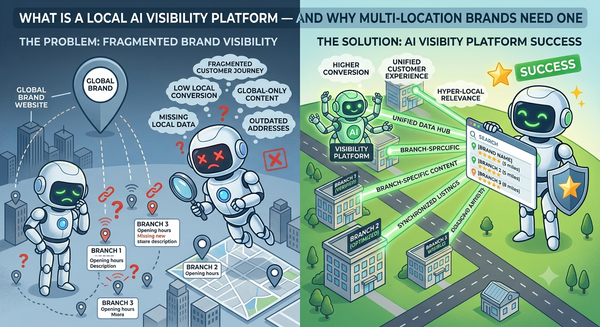
- Branch-specific content is required — a corporate website that proves the brand's credibility cannot prove that a specific location is the best answer for a neighborhood query.
- Purpose-built AEO tools can automate this at scale — systems like Paigent generate branch-level, Gemini-readable content for multi-location brands so each location builds its own local proof.
What Ask Maps Actually Is
Ask Maps is Google's conversational AI layer inside Google Maps, powered by Gemini. When a user opens Maps and asks a question — "who does emergency HVAC repair near me?" or "best sushi restaurant in Midtown?" — Ask Maps doesn't return a ranked list. It returns a recommendation. Three to eight businesses, presented as AI-curated answers, with the AI explaining why each one fits.
The mechanism is distinct from traditional local search in a specific, consequential way. Traditional local search ranks businesses by relevance, proximity, and prominence signals (reviews, citations, backlinks). Ask Maps does something more like a reading comprehension test. Gemini reads the available content about each local business — the website, the Google Business Profile, the reviews, the schema markup — and asks: can I construct a confident, specific, citable answer for this query using what this business has published?
If the answer is yes, the business appears in the top 3–8. If the answer is no — even if that business ranks #1 for the same keyword in organic search — it doesn't appear at all.
That 12% overlap between AI citations and traditional top-10 organic results is the data point that proves these are genuinely different systems. Optimizing for one does not automatically optimize for the other.
How Ask Maps Decides Who to Recommend
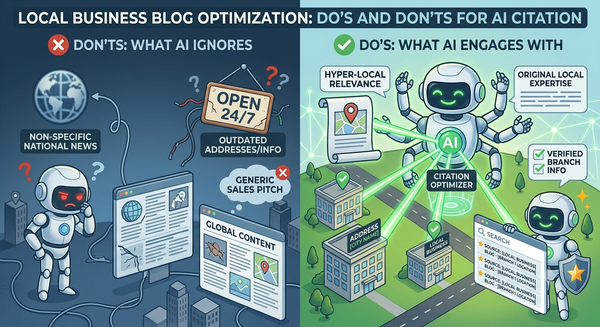
Ask Maps recommendation decisions trace back to a core question: does enough machine-readable, location-specific content exist to justify recommending this branch to someone asking a specific question nearby?
The factors Ask Maps appears to evaluate break down into four areas:
| Signal | What Ask Maps Checks | Why It Matters |
|---|---|---|
| Content specificity | Do your pages answer the questions being asked? | Generic service pages can't answer "do you treat anxious dogs?" or "do you serve gluten-free options?" |
| Review specificity | Do your reviews mention services, staff, outcomes, and location details? | Vague five-star reviews add less signal than reviews naming a specific procedure or neighborhood |
| Profile coherence | Does your website, GBP, and content tell the same story? | Inconsistency lowers Gemini's confidence that it's reading accurate information |
| Freshness | How recently was your content updated? | Research analyzing 17 million AI citations found AI-surfaced URLs are 25.7% fresher than traditional search results (Frase) — recency is a meaningful ranking signal |
The freshness finding is particularly important for multi-location brands that launched location pages once and left them static. Ask Maps doesn't reward evergreen content the way traditional SEO does. A branch page that hasn't been updated in eighteen months is likely being read as stale — and that stale signal directly competes against a local rival who published last week.
Content specificity is where most brands fall shortest. A dental group's corporate site can explain that the brand provides pediatric dentistry. But if a parent in a specific suburb asks "best pediatric dentist near Buckhead," Ask Maps needs to find content that connects that specific branch, in that specific neighborhood, to that specific service. A shared corporate page won't do it.
The Brand AEO vs. Local AEO Distinction
This is the gap most multi-location brands miss — and it's why businesses with strong national SEO footprints sometimes perform worst in Ask Maps.
Brand AEO means your corporate entity is well-understood by AI systems. Gemini knows what your company does, who it serves, and what makes it distinctive. That's useful for brand recognition queries. It does nothing for local intent queries.
Local AEO means a specific branch is well-understood. When someone in Denver searches "best mortgage broker in Denver," Ask Maps needs to find content that proves the Denver branch specifically is the right answer. Not proof that the parent company is a credible lender. Proof that this location understands the Denver market — the neighborhoods, the common loan scenarios, the local competition.
The two are built differently. Brand AEO is centralized, typically handled at the marketing team level through brand-wide content and authority signals. Local AEO is distributed — it requires each branch to have its own content footprint, its own review signals, and its own proof of local market knowledge. A restaurant group with forty locations doesn't need one great page about its cuisine. It needs forty pages proving that each location is the neighborhood answer for queries like "best pasta in Lakeview" or "date night restaurant in Silver Lake."
This is also why every store risks becoming invisible in local AI search without branch-specific content — the corporate site is not a substitute, no matter how authoritative it is.
The Step-by-Step Process for Ask Maps Optimization
Ask Maps optimization is a systematic workflow, not a one-time update. Here's how it operates across the content lifecycle:
- Crawl and ground the branch — before writing anything, pull the real facts for the specific location: actual services offered, service area boundaries, staff credentials, real reviews, and any neighborhood-specific context. Every subsequent content decision is grounded in this data, not generic category assumptions.
- Identify the right queries — using search volume data, map which questions customers are asking AI in that branch's market. "Pediatric dentist Buckhead" is a different query from "same-day dental crowns Atlanta." Each branch's content calendar targets its own relevant query set, not a shared national keyword list.
- Generate Gemini-readable content — write branch-specific content structured to answer AI extraction. This means direct answers in the opening of each section, FAQ schema markup on question-answer pairs, and prose that connects the service to the specific location — not templated copy that could describe any branch anywhere.
- Embed schema markup — FAQ schema, LocalBusiness schema, and service-specific structured data make the content machine-parseable. Schema tells Gemini not just what the page says but what type of entity it's describing and what questions it answers.
- Publish to the brand's own domain — content should live on the business's own website (WordPress or Ghost are common targets), not a third-party directory. Traffic, authority signals, and AI citations accumulate on the domain you own, not on a platform you rent.
- Keep content fresh and monitor signals — Ask Maps recrawls content regularly. A branch that publishes consistently builds a freshness signal; one that publishes once and goes quiet loses ground as competitors publish. Analytics should track where AI engines are sending traffic so the content strategy can adjust as queries evolve.
The timeline to first results is realistic rather than immediate — the 4–8 week window reflects the time it takes Ask Maps to crawl, evaluate, and update its recommendations after new content appears. For multi-location operators, this timeline applies per branch as it goes live, which is why sequencing across locations matters as much as the content itself.
The Scale Problem — and Why Automation Exists
The process above works. For one branch, a capable content team can execute it manually. The problem becomes clear fast: for ten branches, the manual version is painful. For fifty, it's impossible without dedicated infrastructure.
Consider a dental group with thirty clinic locations across a metro region. Each clinic needs its own content proving local expertise. Each clinic's query set differs — some serve communities where Spanish-language content matters, some are known for pediatric care, some compete on same-day availability. Writing, structuring, and publishing fifty unique pieces of clinic-specific content monthly isn't a content team problem. It's an infrastructure problem.
That's where purpose-built AEO content engines enter the picture. They're built to crawl each location's real data, generate branch-specific content that's factually grounded (not templated), apply the right schema, and publish at scale — without fabricating claims or duplicating angles across branches. According to local AEO solution data, industry data suggests that 97% of digital leaders reported a positive impact from AEO strategies in 2025 and 94% planned to increase their investment in 2026, according to research cited by Conductor and reported by Instant Press.
The automation question is not "is this possible manually?" It's "can this be done manually at the speed and volume Ask Maps requires, across every branch, without a dedicated content team?" For most multi-location operators, the honest answer is no.
For service businesses like home services companies or pest control operators with a dozen branches across a region, the gap between "we have a website" and "every branch has fresh, Ask Maps-optimized content" is the gap between invisible and recommended.
Who This Approach Is Best For — and Who Might Consider an Alternative
Ask Maps Optimization delivers clear value in specific situations. Understanding where it fits — and where it doesn't — helps operators make an honest call.
Best suited for:
- Multi-location service brands with three or more physical locations whose customers search locally for specific services
- Operators competing in categories where Ask Maps already shows results (dental, HVAC, salons, restaurants, mortgage, real estate)
- Brands that have Google Business Profiles set up but lack branch-level content to support them
- Businesses seeing strong organic rankings but declining walk-in traffic — a signal that customers are following AI recommendations instead of clicking organic results
Worth pausing on if:
- You operate a single location — the infrastructure overhead is designed for multi-location scale; single-location businesses have simpler, cheaper options
- You run an online-only business with no physical foot traffic to win
- You need results in under thirty days — first Ask Maps lift typically appears in the 4–8 week window as content gets crawled and evaluated; it's not an instant fix
- You want to write and approve every word manually — automated workflows reduce that granular control, and operators who require it will find the process friction
The honest frame: Ask Maps Optimization is a structural investment, not a quick win. It compounds over time as each piece of branch-specific content adds to the location's authority profile. Brands that treat it as a short-term campaign and pause after six weeks typically see modest results. Brands that treat it as an always-on content operation — fresh content, consistent publishing, accumulating proof — are the ones appearing in Ask Maps' top 3–8 consistently.
Where This Fits
For multi-location operators who've watched walk-in traffic flatten while their organic rankings stayed steady, Ask Maps Optimization is the missing piece. A purpose-built AEO/GEO content engine like Paigent is designed precisely for this gap: it automates the crawl, the writing, the schema, and the publishing across branches — so each location builds its own local proof on your own domain, without a content team managing it manually.
If that matches your situation, explore the local AI search and AEO solutions overview to understand what branch-level optimization actually requires.
Frequently Asked Questions
What's the difference between Ask Maps and regular Google Maps search?
Regular Google Maps search returns ranked results based on proximity, reviews, and keyword match — typically a long list. Ask Maps is a conversational AI layer that interprets a natural-language question and returns three to eight recommended businesses it can confidently describe as a good fit. The selection mechanism is content comprehension, not ranking position, so a business ranked highly in standard Maps isn't guaranteed to appear in Ask Maps.
How does Ask Maps decide which businesses to recommend for a local query?
Ask Maps uses Gemini to evaluate available content about nearby businesses. It checks whether the business's website, Google Business Profile, reviews, and schema markup together provide enough specific, coherent, and recent information to confidently answer the user's question. Businesses with branch-level content addressing the exact service and neighborhood query are significantly more likely to appear than those relying only on a generic brand website.
Why doesn't strong traditional SEO performance guarantee Ask Maps visibility?
Research analyzing 15,000 AI prompts with Ahrefs Brand Radar found only 12% overlap between AI-cited URLs and Google's top-10 organic results. The two systems evaluate content differently: traditional SEO rewards authority signals and backlinks, while Ask Maps rewards machine-readable, location-specific content that answers the exact question being asked. A nationally authoritative site can score poorly on Ask Maps if it lacks branch-level proof for local queries.
What is "Gemini-readable content" and how does it differ from standard web content?
Gemini-readable content is written with AI extraction in mind: direct answers at the top of each section rather than buried conclusions, FAQ schema that wraps question-answer pairs in structured markup, and location-specific language that connects a service to a specific branch and geography. Standard web content is written for human reading patterns, which doesn't always map to how AI models extract citable answers. The structural difference is significant enough to affect whether a piece of content gets cited at all.
How long does it take to see results from Ask Maps optimization?
First lift in Ask Maps recommendations typically appears within 4–8 weeks of new content being published and crawled. This reflects the time Ask Maps takes to evaluate fresh content, update its understanding of a business, and adjust recommendations. It is not an immediate channel. For multi-location operators, results also scale with deployment sequence — branches that go live earlier accumulate authority sooner.
Can a dental clinic or HVAC company realistically execute Ask Maps optimization without a dedicated marketing team?
Yes, but not manually at scale. A single clinic or branch can manage the content process with a small team if the volume stays low. For multi-location operators — dental groups with fifteen-plus clinics, HVAC companies with a dozen branches — the per-branch content requirements make manual execution impractical. Purpose-built systems designed for Ask Maps visibility automate the crawl, generation, schema, and publishing steps so operators without content teams can maintain fresh, optimized content across every location.
What role do customer reviews play in Ask Maps recommendations?
Reviews are one of several signals Ask Maps evaluates, and specificity matters more than volume. A review that mentions a specific service ("they fixed my AC in under two hours on a Saturday"), a staff member, or a neighborhood detail gives Ask Maps more usable content than a generic five-star rating with no text. Businesses can strengthen their review signals by making it easy for customers to leave detailed reviews — including removing friction from the review process itself.