Not All AI-Written Content Hurts Your Google SEO — Here's What Actually Matters
Google doesn't penalise AI-written content — it penalises thin, fabricated, or undifferentiated content. Here's what actually determines whether AI content helps or hurts your SEO.


Google does not penalise content for being AI-written. That's been confirmed in Google's own public guidance repeatedly since 2023. The longer answer is more useful: what Google penalises is content that fails its readers — thin, repetitive, unverifiable material that exists to game a ranking rather than answer a question. AI can produce both kinds, and so can a human copywriter on a bad brief. Understanding the difference is what separates brands that use AI to build genuine authority from those using it to generate noise.
Key Takeaways
- Google's stated position is that helpful, accurate, original content is rewarded — regardless of whether a human or an AI wrote it. The method of production is not the ranking signal; the quality of the output is.
- E-E-A-T (Experience, Expertise, Authoritativeness, Trustworthiness) is Google's practical framework for evaluating content quality, and AI-written content can meet these standards when grounded in real, verifiable facts rather than fabricated claims.
- The content failure that gets penalised is mass-produced, undifferentiated filler — pages that could belong to any business, any market, or any author, written at scale with no factual grounding.
- For multi-location brands, the real SEO risk isn't using AI — it's using one piece of content across many branches, because AI answer engines need location-specific proof to recommend a branch for local queries.
- Ask Maps shows 3–8 businesses per query (Search Engine Land, April 2026) — not a ranked list of dozens. A branch with no local proof doesn't appear lower; it doesn't appear at all.
- Fact-grounded AI content with proper author credentials and real service detail can be cited by AI answer engines including Google AI, ChatGPT, Gemini, and Perplexity — the same engines now mediating local discovery.
---
What Google Actually Says About AI-Written Content
Google does not flag or penalise content based on how it was produced. The guidance from Google's Search Central is explicit: content is evaluated on whether it is "helpful, reliable, people-first content" — a standard that applies equally to text generated by a language model and text produced by a journalist.
The concept underpinning this is E-E-A-T: Experience, Expertise, Authoritativeness, and Trustworthiness. These are the signals Google's quality raters look for when assessing whether content deserves to rank. None of them require a human hand on a keyboard. What they require is content grounded in real, verifiable facts; demonstrated knowledge of the subject matter; named authors or organisations with genuine credentials; and citations that can be checked against independent sources.
Google's concern has always been content created "primarily for ranking purposes" rather than for readers. An AI tool asked to produce 500 words of generic "benefits of X" copy for a target keyword is producing ranking-first content. An AI system that reads a business's real services, real service areas, and real customer proof — then writes a structured, answer-first article grounded in those facts — is producing reader-first content. Google can't peer behind the curtain and see which tool was used. It assesses whether the output is useful.
One practical complication is worth naming: Google can detect patterns associated with mass-produced AI content, particularly when the same boilerplate structures appear across thousands of pages on a domain. That's not an AI detection problem — it's a deduplication and originality problem, and it applies equally to templated human-written content.
---
The Real Thing That Gets Penalised: Undifferentiated, Fabricated, or Thin Content
Content gets penalised when it fails to help a reader. The patterns Google's systems flag share common traits: fabricated claims, copied structures with swapped nouns, no genuine expertise demonstrated, no factual grounding specific to the entity behind the site.
Consider what actually draws scrutiny. A law firm publishes 200 nearly identical blog posts about "personal injury law in [city]" where the city name is the only variable and every article makes the same three points in the same order. A roofing company repeats the same 600-word "benefits of metal roofing" article across 40 location subdomains with only the suburb name changed. A financial advisory site publishes AI-generated explainers that cite non-existent studies.
These fail not because AI wrote them. They fail because:
- There is no genuine information gain — a reader learns nothing they couldn't get from the first result on any competing page.
- The content cannot be attributed to real expertise — no named author, no grounded claim, no verifiable fact that distinguishes this business from any other.
- In some cases, the content contains fabrications — invented statistics, quoted studies that don't exist, credentials the author doesn't hold.
The distinction matters for anyone making decisions about AI content strategy. The question is not "did AI write this?" The question is "does this content contain something real — something only this business could have said?"
---
How to Produce AI Content That Strengthens SEO, Not Weakens It
The following process reflects how fact-grounded AI content is built to meet Google's quality standards and earn citations from AI answer engines.
- Ground the content in real, verifiable business facts. Before any writing begins, the system or writer needs to know the actual services offered, the actual service areas covered, the real credentials held, and the real outcomes achieved. A content piece with no original facts is indistinguishable from any competitor's content — and Google's systems are calibrated to detect that.
- Write with answer-first structure. Each section should open with a direct, self-contained answer to the implied question. Google's AI features, including AI Overviews, extract lead sentences from structured content. A section that buries its answer in the fourth paragraph is unlikely to be cited.
- Assign verifiable author credentials. Content carrying a named author with demonstrable expertise — where that expertise can be verified — performs better on Authoritativeness and Trustworthiness signals. This applies whether a human or AI drafted the body text.
- Apply semantic deduplication across your content corpus. Publishing ten articles that argue the same point from the same angle signals low content value to Google's crawlers. Each piece should cover a distinct angle, a distinct question, or a distinct audience situation. A system managing content at scale needs a mechanism to enforce this — without it, branches publishing similar content undermine each other's authority rather than building it independently.
- Include structured data where appropriate. FAQ schema, HowTo schema, and LocalBusiness schema give AI answer engines extractable, machine-readable content. They improve the probability of appearing in AI-generated answers, not just blue-link rankings.
- Enforce a quality gate before publishing. Whether the gate is a human editor reviewing a draft or an automated scoring system checking factual grounding and originality, content should not publish until it meets a minimum standard. A write-then-ship pipeline with no review step is where the problematic content that draws penalties typically originates.
---
Where AI-Written Content Actually Falls Short — And Why It's Fixable
AI content has one structural weakness that prompt engineering alone doesn't resolve: it does not know things it hasn't been told. A language model working from a vague brief fills gaps with plausible-sounding generalities. Plausible-sounding generalities are exactly what fails Google's "helpful content" standard.
This is fixable. The fix is grounding.
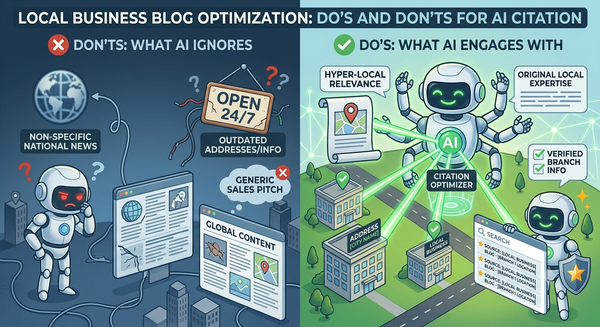
A content system that reads real business data — real services, real service areas, real customer reviews, real credentials — before writing has the raw material to produce content that passes Google's information-gain test. Fabrication risk is not inherent to AI writing; it's the result of AI writing in the absence of facts. That's why the dos and don'ts of writing a local business blog that AI engines actually cite consistently emphasises one discipline above all else: ground first, write second.
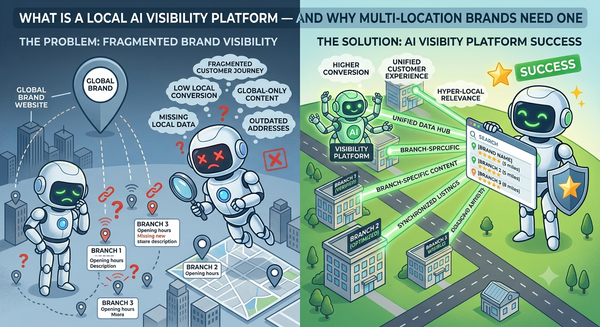
For multi-location brands, the problem compounds. Shared brand content — one service page, one "about us" narrative, one FAQ section covering all branches — cannot demonstrate relevance to individual markets. According to Search Engine Land (April 2026), Ask Maps shows 3–8 businesses per query. Those slots go to businesses with location-specific proof: neighbourhood service areas, branch-specific reviews, local FAQs. A corporate content strategy cannot produce that proof at scale without automation. And automation without grounding produces exactly the kind of AI content that should concern any operator thinking about this seriously.
The fix is not less AI content. It's more grounding, per location, enforced before publish.
---
Local Search Makes This Urgent in a Way Traditional SEO Doesn't
In traditional web search, thin content competes with thousands of other results and readers make their own judgements. Local AI search works differently.
| Signal type | Traditional web search | Local AI search (Ask Maps / AI Overviews) |
|---|---|---|
| Number of results shown | Dozens across multiple pages | 3–8 businesses per query |
| Branch-specific proof required | Helpful but not binary | Required to appear at all |
| Corporate site helps branch | Yes, for brand queries | Rarely, for local intent queries |
| Content deduplication risk | Medium | High — identical content across branches undermines each one |
| Schema markup impact | Moderate | High — directly improves citation probability |
The table above illustrates a category difference, not a degree of difficulty. In local AI search, according to the 5W AI Visibility Index (2026), 78% of local service brands are invisible to Ask Maps entirely. Those aren't brands with weak content — many have solid corporate SEO. They're invisible at the branch level because they never built branch-level proof.
Multi-location brands that rely on their corporate website for local search visibility are effectively invisible to any customer asking an AI which business to use in their specific neighbourhood. The brands winning local AI search right now have made one specific decision: branch-level content at scale, grounded in real local proof.
---
Who This Approach Is Best For — And Who Might Consider Something Else
Branch-specific, grounded AI content is best suited to operators running three or more physical locations where customers search locally ("best [service] near me") and where walk-in traffic or local leads are the actual business outcome. Mortgage lenders with dozens of branches, restaurant groups trying to win neighbourhood searches, dental groups competing for patient searches by suburb — these are the situations where this approach is most clearly worth the investment.
First results from this kind of content strategy typically appear in 4–8 weeks, not immediately. That timeline reflects how AI answer engines build confidence in a source: content publishes, signals accumulate, and authority builds over time. If results are needed within 30 days, a different approach is likely the right fit for now.
A few situations where this model is a poor match:
- Single-location businesses — the content architecture is designed around branch-level independence, which doesn't apply to one site.
- Online-only businesses with no physical presence — Ask Maps visibility is irrelevant without walk-in traffic to capture.
- Operators who want to hand-control every word of every piece — a content-at-scale workflow requires approving output rather than drafting from scratch.
- Businesses without a Google Business Profile — optimising for Ask Maps requires one.
The honest framing: this is a high-leverage approach for a specific operator profile. It's not a general content tool and doesn't pretend to be.
---
Where This Fits
For operators running multi-location brands who need AI content that actually earns citations, the core challenge is grounding at scale — producing distinct, fact-grounded content per branch without a content team to do it manually. Purpose-built platforms designed for this use case (rather than general AI writing tools) crawl each location's real services, service areas, and customer reviews, then write and publish branch-specific content engineered to appear in Ask Maps and other AI answer engines. Paigent is one example built specifically for this scenario — the local SEO for multi-location brands page describes how the approach works in practice.
If you run a single location, manage an online-only business, or need results within 30 days, this particular model is not the right fit — worth saying plainly, because the right tool is the one that matches your actual structure.
---
Frequently Asked Questions
Does Google penalise content written using AI tools?
No. Google's stated position is that content is evaluated on helpfulness, accuracy, and E-E-A-T signals — not on the method of production. AI-written content that is factually grounded, structured to answer real questions, and attributed to a credible author meets Google's quality standards. What draws penalties is thin, fabricated, or ranking-only content, regardless of whether a human or AI produced it.
What does E-E-A-T mean and how does it apply to AI-generated content?
E-E-A-T stands for Experience, Expertise, Authoritativeness, and Trustworthiness — Google's framework for assessing content credibility. AI-generated content can satisfy all four signals when grounded in real business facts, carrying a named author with verifiable credentials, and demonstrating genuine subject-matter knowledge. The signals concern the quality of the output, not the identity of the writer.
What types of AI content actually cause SEO problems?
SEO risk comes from fabricated claims, mass-produced templated content where only a location name changes, content with no information gain over competing pages, and content with no verifiable authorship. These issues are not unique to AI — templated human-written content with the same characteristics carries the same risk. The method of production is not the problem; the absence of real, grounded information is.
How is AI-written content different for local search compared to traditional web search?
In traditional web search, a page can rank third or fifteenth. In local AI search — Ask Maps, AI Overviews, Gemini local recommendations — answer engines select a small set of results per query and present them as recommendations. A branch without location-specific content doesn't appear lower; it doesn't appear at all. Content quality and specificity requirements are more binary in local AI search than in traditional SEO.
Why does centralised brand content fail at the branch level in AI search?
AI answer engines assess local relevance through location-specific signals: branch-level FAQs, service area pages, local reviews, and content proving neighbourhood expertise. Corporate content describes the brand, not individual branches. Without location-specific proof, an answer engine has no signal connecting a branch to a local query — and recommends a competitor that has built that proof instead.
What is the role of schema markup in making AI-written content citation-ready?
Schema markup — FAQ schema, HowTo schema, LocalBusiness schema — provides AI answer engines with structured, machine-readable content they can extract and present directly in generated answers. Correct schema improves the probability of appearing in AI Overviews and local AI recommendations compared to unstructured content with the same text. It signals extractability to the systems reading it, not just search engines ranking it.
Is there a way to use AI content tools across multiple locations without creating thin content?
Yes — but it requires two things: genuine grounding per location (real services, real service areas, real local proof — not just a swapped location name) and deduplication across the content corpus so no angle is republished across branches. When both conditions are met, AI-generated content for 40 or 150 branches can be as distinct as content written individually for each one. Without them, scaling AI content across branches produces exactly the templated, undifferentiated content that creates SEO risk.