Why Your Corporate Website Won't Rank for Local Searches at Each Branch Location
Your corporate website can't rank for local searches at each branch. Learn why local AI search requires branch-specific proof — and how to build it at scale.

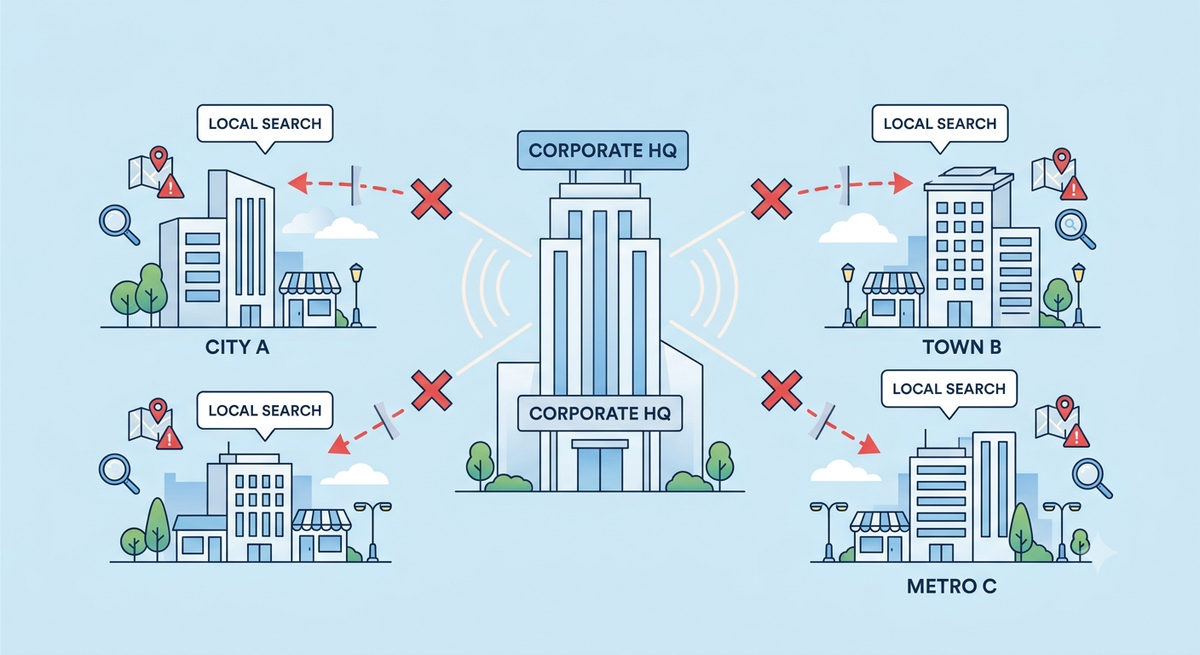
A corporate website builds brand recognition. It does not build local authority. Those are two different problems, and most multi-location brands are solving only one of them. Search engines deciding which businesses to recommend for a query like "best HVAC company near me" are looking for location-specific proof tied to that exact address — not a polished national brand page. This post explains why centralized sites fail at the branch level, what signals actually determine local visibility, and how operators running dozens of locations can close the gap systematically.
Key Takeaways
- Brand AEO ≠ Local AEO — centralized brand content builds brand-level authority, but search engines require branch-specific proof to rank each location for its local market.
- Ask Maps surfaces 3–8 businesses per query — not a long list of organic results — which means every local search has a small, winner-take-most outcome (Search Engine Land, April 2026).
- 78% of local service brands are invisible to Ask Maps — the majority of multi-location operators are not appearing in the recommendation layer at all (5W AI Visibility Index, 2026).
- The average multi-location brand fails to appear in 3 out of 4 local searches and ignores over 50% of reviews, according to the 2024 SOCi Local Visibility Index, which analyzed nearly 3,000 enterprise companies representing 2.8 million locations.
- Location-specific content produces measurable ranking lifts — a study by Wiideman found a 107% improvement in rankings when using hyperlocal content on dedicated branch pages, as reported by BrightLocal.
- Branches with optimized profiles are more likely to appear in Ask Maps recommendations — profile completeness and fresh, location-specific content are direct signals in the recommendation algorithm (Map Ranks, 2026).
The Real Reason Your Corporate Site Can't Win Local Searches
Corporate websites are engineered for brand authority. They carry domain history, inbound links, and content written to represent the organization as a whole. Those are genuine strengths — for brand-level queries.
Local search works differently. When someone opens Google Maps and types "best pediatric dentist near me" or "emergency plumber in Scottsdale," the algorithm is asking a different question: which specific location, at a specific address, has demonstrated expertise in this service for people in this geographic area? The corporate site cannot answer that question, because it was never designed to.
The underlying mechanics matter here. Local AI search, including Google Ask Maps, evaluates signals at the branch level: the Google Business Profile for that address, the content associated with that location, the reviews mentioning specific services in that neighborhood, and the structured data tied to that branch's physical details. A single centralized site shares none of those signals across individual locations. It provides brand context, not local proof.
This is the Brand AEO ≠ Local AEO gap. Brand AEO builds authority for who you are. Local AEO builds authority for what you do, here, in this neighborhood, for these customers. Without location-specific proof at each branch, the corporate domain is essentially invisible to the algorithm deciding who gets recommended when a customer searches locally.
The distinction becomes sharper in competitive markets. When Ask Maps shows only 3–8 businesses per query, ranking outside that window is equivalent to not ranking at all. A dental chain with 40 locations sharing a single brand site is competing against individual clinics that have dedicated, optimized content for each local market. The chain's aggregate domain authority does not compensate for missing branch-level signals.
What "Local Proof" Actually Means for Search Engines
The phrase "local proof" gets used loosely. For search algorithms, it refers to a specific cluster of signals. Understanding them is how you diagnose exactly what your branches are missing.
Google Business Profile completeness and freshness. Each branch needs its own GBP, fully populated, with current hours, service categories, photos, and regular activity. A stale or incomplete GBP is the first disqualifier.
Location-specific content. Content tied to a branch address — service pages mentioning the local area, FAQs specific to neighborhood service conditions, blog content addressing local customer needs. Generic content copied from the brand site adds no local signal.
Structured data at the branch level. LocalBusiness, FAQPage, and Review JSON-LD schema deployed per location help answer engines parse and extract the right information for recommendation decisions. Schema applied at the corporate level does not disaggregate to individual branches.
Review signals. Volume, recency, and specificity of reviews mentioning local services and location details. A Denver mortgage branch and a Miami mortgage branch need separate review bodies — reviews from one market do not prove relevance for the other.
Neighborhood-specific proof. Content demonstrating micro-market expertise: the specific service conditions in that zip code, the local context for a service category, the area-specific FAQs customers actually ask.
Each of these signals must exist independently for each branch. They cannot be inherited from the parent domain.
How Multi-Location Brands Actually Lose Visibility Without Knowing It
Here is a scenario that plays out across industries. A restaurant group with 30 locations has invested in brand SEO. The main domain ranks well for branded queries. Marketing is satisfied.
Meanwhile, a customer in Beverly Hills opens Maps and asks for "best sushi near me." Ask Maps returns 3–8 recommendations. The chain's Beverly Hills location isn't one of them — because it has no dedicated content proving it's the right answer for sushi in Beverly Hills. A smaller, independent restaurant with a complete GBP, fresh location-specific content, and recent reviews mentioning specific dishes and the neighborhood appears instead.
The same dynamic affects HVAC and plumbing companies competing for emergency calls. A homeowner searching "who can fix my AC right now" at 2 AM doesn't browse organic results. Ask Maps recommends 3–8 local businesses immediately. Branches without branch-specific content are excluded from that recommendation set — regardless of brand reputation.
Dental clinics face the same ceiling. A patient searching "best pediatric dentist near me" sees an AI-curated list. A clinic with an Ask Maps-optimized profile, location-specific FAQs, and fresh review signals appears. A clinic relying on the brand site does not.
Brand awareness does not translate into local AI recommendations. Those are separate algorithms with separate inputs.
A Step-by-Step Process for Building Branch-Level Local Authority
Fixing the local visibility gap is a systematic process, not a one-time content task. The steps below address the root cause: each branch needs its own proof, built and maintained independently.
- Audit each branch's current local signals. For every location, check GBP completeness, the presence of location-specific content, schema deployment, and recent review volume. This surfaces exactly which branches are invisible and why.
- Set up a dedicated content structure per branch. Each location needs its own content home — a dedicated page or profile that search engines can index as specific to that address and service area. Not a corporate page with a location filter, but a genuinely independent content node per branch.
- Identify what makes each branch locally distinct. Service conditions vary by neighborhood. A cleaning company branch in a dense urban zip code has different local context than one in a suburban market. AI-driven content identification can surface the specific topics, services, and local questions relevant to each branch's micro-market.
- Generate location-specific content for each branch. Branch profiles, service pages, FAQ schema, and review-backed content — all tied to that specific address and service area. This is the content layer that answer engines read when deciding which businesses to recommend.
- Deploy structured data at the branch level. LocalBusiness, FAQPage, and Review JSON-LD schema must be published per location. Corporate-level schema does not provide the granular branch signals that recommendation algorithms evaluate.
- Maintain freshness with regular content and GBP sync. Local authority is not static. Weekly content refresh cycles and daily GBP syncs keep each branch's signals current — an important input for algorithms that weight recency.
This process applies across service verticals. Home services operators, electricians, and general contractors all face the same underlying structure: each branch must earn its own local relevance, independently of the brand.
Why Scaling This Manually Breaks Down Fast
For a brand with 5 locations, manual content creation is difficult. For a brand with 50 or 150, it is not a realistic strategy.
Writing branch-specific content, deploying schema, managing GBP sync, and collecting reviews for 10 branches requires significant time even with a dedicated marketing team. Most multi-location operators — HVAC companies, cleaning services, landscaping firms, dental groups — don't have dedicated marketing teams per branch. They have one operator managing dozens of locations.
The math does not work. If each branch needs fresh, location-specific content updated weekly, and you have 40 branches, you're looking at a volume of content work that outpaces any manual process. This is why the multi-location local search problem persists even at brands that understand it intellectually. The operational cost of solving it manually is prohibitive.
Fully optimized multi-location enterprises achieve nearly double the Google 3-pack presence of average multi-location brands — 65.7% versus 33.4%, according to SOCi research. The gap between those two numbers is, in large part, a content production and consistency gap. The brands at 65.7% have solved the operational side of local content at scale. Most haven't.
Where This Fits
Ask Maps is deciding right now who ranks in your market. For multi-location service brands — restaurant groups, dental clinics, landscaping companies, cleaning services — that need each branch visible in local AI recommendations without a marketing team per location, Paigent automates the entire workflow: branch-specific content generation, schema deployment, GBP sync, and review collection in 77 languages, all on a daily and weekly cadence. First Ask Maps ranking improvements typically appear in 4–8 weeks as branch authority accumulates. It is built for operators with 3 or more branches who need the Brand AEO ≠ Local AEO gap closed at scale — not for single-location businesses or operators who want to manually control every line of content.
Who This Approach Is Best For — and Who Might Consider an Alternative
Multi-location operators with 3 or more branches, competing in service categories where customers search locally ("best [service] near me"), are best suited for an automated branch-content approach. The return on solving the local visibility gap compounds as branch count increases — 50 branches winning local searches represents a different business outcome than 2.
If you're running a single location, the local content problem is still real, but the operational case for automation is different. A single well-managed GBP, a focused review collection process, and manually written location content may be sufficient without a platform.
Operators who need results within 30 days should calibrate expectations. Ask Maps authority builds over time as content publishes and signals accumulate. First meaningful improvements typically appear in 4–8 weeks. This is not a sprint channel.
If your primary need is a general content creation tool — blog posts, social copy, brand storytelling — a different category of tool fits that job. An automated Ask Maps visibility platform is designed specifically for local recommendation signals, not broad content production. For a detailed look at how purpose-built AI tools compare with general-purpose alternatives, Paigent vs. Jasper covers that distinction directly.
Operators who want to manually approve and control every piece of content before publication should confirm that any platform they choose supports that workflow. Automated platforms are built for throughput — manual override options vary.
If your business doesn't yet have a Google Business Profile for each branch, that foundation needs to be in place first. No local content strategy, automated or manual, can optimize an Ask Maps presence that doesn't have a GBP anchor.
Ready to see which of your branches are invisible right now? Visit getpaigent.com to run a branch visibility check.
Frequently Asked Questions
What is the difference between Brand AEO and Local AEO?
Brand AEO builds authority for your business as an entity — who you are, what you do, and why you're credible at the brand level. Local AEO builds authority for each specific branch location — proving that this address serves this neighborhood for this service. A corporate site can achieve strong Brand AEO while every branch remains invisible in local AI recommendations because the two require different content signals and different optimization targets.
Why does Google Ask Maps show only 3–8 businesses instead of a full list of results?
Ask Maps is a recommendation engine, not a search result list. It surfaces a curated set of businesses — typically 3–8 per query — based on proximity, relevance, and the strength of local proof signals for each location. This is structurally different from traditional organic search, where dozens of results appear. The small recommendation set means that branches outside the top results receive effectively zero visibility from that query.
Can a location page on a corporate website substitute for a dedicated branch content strategy?
A location page on a corporate site is better than nothing, but it rarely provides sufficient local proof to compete in Ask Maps. Effective branch content requires independent indexing signals, branch-specific FAQ schema, fresh location-associated reviews, and structured data tied to that specific address. A filtered page on a corporate domain typically shares domain signals without generating the branch-level specificity that recommendation algorithms evaluate.
How long does it take for branch-specific content to improve local search rankings?
Ask Maps authority builds incrementally as content publishes, schema is indexed, and review signals accumulate. The typical window for first measurable improvements is 4–8 weeks from when branch-specific content is live and GBP signals are active. Operators expecting results in under 30 days should plan for a longer horizon — local AI recommendation signals are not instant.
What role does structured data (schema) play in local branch visibility?
Structured data — specifically LocalBusiness, FAQPage, and Review JSON-LD schema deployed per branch — helps search engines parse and extract branch-specific information for recommendation decisions. Without schema at the branch level, answer engines have to infer details from unstructured content. With correctly deployed schema, each branch presents machine-readable proof of its location, services, and customer signals, which directly improves its ability to appear in Ask Maps recommendations.
How does review collection affect a branch's Ask Maps ranking?
Reviews tied to a specific branch location are a direct input to local recommendation algorithms. Volume, recency, and content specificity all matter — reviews that mention the local area, specific services, and staff details provide richer signals than generic ratings. Review bodies for each branch should be independent: reviews from a Denver location do not strengthen Ask Maps relevance for a Miami location, even within the same brand.
Why do multi-location brands with good SEO rankings still lose walk-in traffic?
Organic SEO and Ask Maps recommendations are different surfaces. A brand can rank well in traditional organic results while being absent from the 3–8 businesses surfaced in Ask Maps. As more customers search locally using conversational queries in Maps rather than clicking organic links, good organic rankings no longer translate directly into branch-level walk-ins. The shift toward AI-curated local recommendations means that branch visibility in Ask Maps has become a separate, critical channel from traditional search ranking.